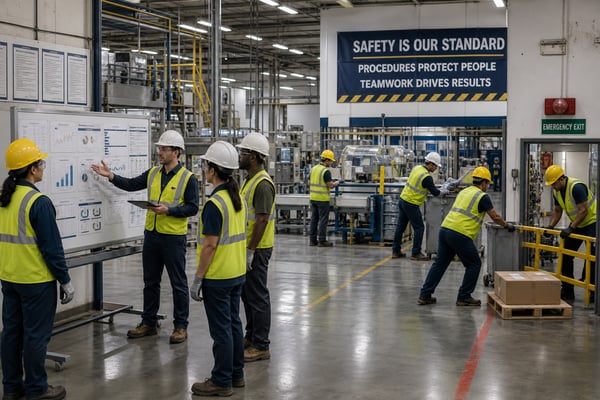
When we walk into a struggling factory, the list of problems is never short. Equipment is failing, quality is inconsistent, deliveries are late, turnover is high, and management is overwhelmed. Sometimes it seems that everything needs fixing. The question every client asks is: where do we start? After hundreds of assessments, we have a clear answer: take a critical look at what needs to be done and create a plan to tackle the problems in sequence.
Written by David Collins III, CEO of Manufacturing Transformation Group.
The Trap: Trying to Fix Everything at Once
The natural instinct from management after an assessment is to attack everything simultaneously. If the factory decides to make the improvement themselves the situation is worse. The leadership team sees 30 findings. They assign 30 action items. They set a 90-day deadline for all of them with no particular order except get them done yesterday. They often do not understand that things take time and don't have to personally deal with the hard work to implement change.
When everything is priority one, nothing is priority one. The supervisors who are supposed to execute the improvements are the same people fighting daily fires. They cannot absorb 30 new tasks on top of keeping production running. So they do what any rational person would do — they focus on today's emergency and let the improvement plan slip. In manufacturing the top priority is to make production. Anything else is secondary. My father told me that, when he worked for a major auto manufacturer, the plant would throw all its resources to meet monthly quotes even it meant excessive overtime, quality problems, and delay of critical maintenance. How can a factory focus on improvements when it is under that pressure and there is no implementation plan.
Don't we do this in our own lives? Putting off fixing the patio because the grind of each day takes up enough time and it is less "immediate" (even if planks are rotting through).
We have seen this pattern at factories in every country we work in. The solution is not more action items. It is fewer, better-chosen action items executed in the right sequence. Lasting improvement takes time and careful thought to execute.
The Framework: Impact vs Effort
Every finding from an assessment can be plotted on two axes: how much impact it will have, and how much effort it will require.
This produces four categories:
Quick wins (high impact, low effort) — These go first. They build momentum, demonstrate that change is possible, and earn credibility with the workforce. Examples: starting a daily standup meeting, posting KPI boards on the floor, fixing a recurring safety hazard, clearing blocked escape routes. We like these because they are highly visible and create buy-in from the team. People have a preference for action over inaction so positive visual improvements make an immediate difference.
Strategic improvements (high impact, high effort) — These are planned as phased projects over 3-6 months. Examples: implementing a preventive maintenance program, building a standard work system, redesigning the production layout, upgrading critical equipment. Do not rush these. Redesigning the production line requires a lot of planning to successfully implement. You need to communicate the changes to the staff, educate them on the process, and provide support to minimize overall disruption.
Fill-ins (low impact, low effort) — Do these when capacity allows. They are nice to have but do not move the needle. Examples: updating signage, reorganizing the tool crib, repainting floor markings. We have often found that these are finished early on, as long as a factory is not overwhelmed
Deprioritize (low impact, high effort) — Acknowledge these exist but do not chase them. The worst use of limited resources is spending six months on a complex project that delivers marginal results. Examples: a full ERP implementation when the factory does not even have daily KPI reviews, an automation project when the process is not yet standardized.
The discipline is in the deprioritize category. Most improvement plans fail because they include too many items from the strategic and deprioritize quadrants and not enough from the quick wins.
The Sequence That Works
Across hundreds of factory engagements, we have settled on a sequence that works regardless of industry, country, or factory size. The order is not arbitrary — each step creates the foundation for the next.
Step 1: Safety
If people are getting hurt or are at risk of getting hurt, nothing else matters until that is addressed. You cannot ask operators to focus on quality or productivity when they are worried about losing a finger.
Safety fixes are almost always quick wins. Clearing blocked exits. Fixing machine guards. Replacing worn PPE. Cleaning oil from walkways. These cost almost nothing and can be done in days.
In the worst factory we ever assessed, the safety conditions were so bad that one of our consultants asked if we offer hazard pay. Escape routes were blocked, stairways covered in oil, flammable materials near open furnaces. We addressed safety before anything else — not because it would improve throughput, but because it was the right thing to do and because no improvement plan survives if someone gets seriously hurt in the first week.
Step 2: Daily Management
This is the single most important step. Without daily management, every other improvement will decay within weeks.
Daily management means: a 15-minute standup meeting at each production area, every shift. Three to four KPIs on a visual board. Red items get an owner and a deadline. The next day, the first question is whether yesterday's red items were resolved.
Why does this come before maintenance, before standard work, before everything else? Because daily management is the enforcement mechanism for everything that follows. When you implement a maintenance schedule in Step 3, it is the daily standup that catches a missed PM task the next morning. When you roll out standard work in Step 4, it is the daily review that identifies when operators are deviating from the standard.
Without daily management, improvements are launched with fanfare and forgotten within a month. With daily management, problems are caught in 24 hours instead of festering for weeks.
Step 3: Maintenance
Once you have a daily management system running, add unplanned downtime as one of the tracked KPIs. The daily reviews will naturally drive attention to your worst equipment.
Start with the top five failure modes — the breakdowns that happen most often on the machines that matter most. Build a preventive maintenance schedule around those specific failures. Order the spare parts that keep causing emergency purchases.
Do not try to build a comprehensive PM program for every machine on day one. That is a strategic improvement, not a quick win. Start with the five machines that cause the most pain and expand from there.
Step 4: Standard Work
This comes last in the initial sequence — not because it is least important, but because it requires stability to implement. You cannot standardize a process that changes every time a machine breaks down or an operator calls in sick.
Once safety is addressed, daily management is running, and the worst equipment failures are under control, the process is stable enough to document. Have your best operators write the standard work instructions while they perform the task. Validate them by having a less experienced operator follow the instructions. Post them at the workstation.
Standard work is the longest effort but the most durable. It is what prevents the factory from sliding back after the consultants leave or after leadership attention moves to the next crisis.
The 30-60-90 Day Rhythm
The 30-60-90 Day rhythm is the Platonic ideal for change. Does not always work this way but the general structure and format hold true across a vast majority of the engagements.
First 30 days: Stabilize. Safety fixes. Daily management launched. Quick wins executed. The goal is to stop the bleeding and demonstrate that change is happening. This is where you earn the trust of the workforce — or lose it.
Days 30-60: Build systems. Maintenance schedule for top failure modes. First standard work documents for highest-volume processes. KPI tracking expanded beyond the initial 3-4 metrics. The daily standup is now routine, not a novelty.
Days 60-90: Sustain and expand. Maintenance program extended to more equipment. Standard work rolled out to more workstations. Supervisors are running the daily standups without outside facilitation. The improvement system is self-sustaining.
Beyond this structure days, the factory should be able to continue improving on its own — using the daily management system, maintenance program, and standard work as the infrastructure for ongoing improvement. If it cannot, the systems were not embedded deeply enough and need reinforcement.
It is important to note that this not a literal "30-60-90" days. At MTG, we often support a gradual approach that requires giving our clients "homework". We help develop and implement systems and then give a week or two for the factory to run without our people on-site. Sometimes they need more help; sometimes the factory takes the improvements and runs with it. The systems that are implemented should be self sustaining.
The Three Rules
After doing this hundreds of times, we have distilled the prioritization process down to three rules:
Rule 1: No more than five priorities at a time. The human brain can manage about three to five active projects. More than that and execution quality drops. When the first five are done, add the next five.
Rule 2: Every action needs a name and specific position, not a department. "Maintenance will fix the press" is not an action item. "Carlos will replace the hydraulic seal on Press 3 by Friday" is an action item. Departments do not do things. People do.
Rule 3: If you are not following up daily, it is not a priority. Action items that are reviewed monthly are wishes. Action items that are reviewed weekly are goals. Action items that are reviewed daily are priorities. The daily standup is where priorities live or die.
Where Most Companies Get the Sequence Wrong
The most common mistake we see is jumping straight to Step 4 (standard work) or even further ahead to technology solutions (new ERP, automation, AI-powered inspection) without building the foundation first. Automating wasteful processes does not increase effectiveness; it automates waste. I know I have told this story before but one of our clients bought a large automated line for over $1M without the systems to build around it. It turned into a very expensive, but admittedly effective, coat rack.
A factory that cannot run a daily standup meeting is not ready for standard work. A factory that has no maintenance schedule is not ready for automation. A factory with blocked escape routes and oil-covered floors is not ready for anything except fixing the basics.
The sequence matters because each step creates the conditions for the next. Skip a step and the improvements built on top of it will collapse.
The factories that improve fastest are not the ones with the biggest budgets or the most sophisticated technology. They are the ones that start with a whiteboard, a daily meeting, and the discipline to follow up every single day.
Need help prioritizing?
Manufacturing Transformation Group starts every engagement with a structured assessment that identifies the highest-impact opportunities and builds a prioritized action plan. We stay on the ground through implementation to make sure the plan actually gets executed. Get in touch to discuss your factory.