

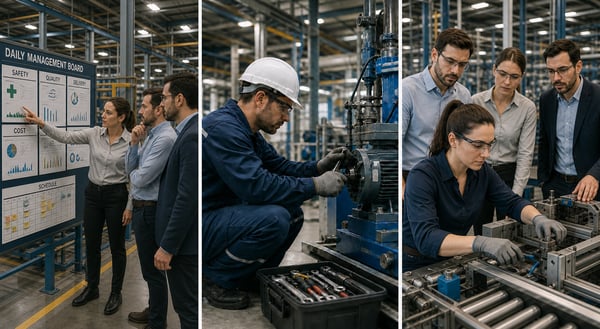
After assessing hundreds of manufacturing facilities across China, Vietnam, Mexico, Europe, and the US, we have found that the same three problems appear in nearly every factory we walk into. They cross industries, geographies, and company sizes. They are not exotic or complicated. They are manufacturing fundamentals and they are costing factories millions in lost productivity, quality failures, and missed deliveries.
Written by David Collins III, CEO of Manufacturing Transformation Group.
Problem #1: No Daily Management System
Almost every factory we assess has KPIs. They are somewhere on site perhaps in a binder or on a dashboard that someone built in Excel two years ago. Or on a whiteboard in the manager's office that was last updated in March. Sometimes, the KPIs are as basic as the required production per day.
The data (or at least the daily production goals) exists. The problem is that nobody uses it to drive daily decisions. Decisions are driven by making production and getting through the day.
Here is what we typically find: the factory tracks production output, scrap rate, on-time delivery, and maybe OEE. Management reviews these numbers monthly. Sometimes weekly. The review produces a list of action items. Some of those items get done. Most do not. By the next review, the same problems are back — plus a few new ones.
It is not only a KPI problem: it is a cadence problem. Monthly reviews are autopsies and are never quick enough to deal with critical problems. They tell you what went wrong after it is too late to fix it. By the time you discover that Line 3's scrap rate spiked to 8% last month, you have already shipped thousands of bad parts or scrapped thousands of dollars in material. Either scenario is bad for the bottom line.
What good looks like: A 10-15 minute standup meeting at each production area, every day, at the start of each shift. Three to four KPIs on a visual board — updated before the meeting starts. Red items get an owner and a deadline on the spot. The next day, the first question is: "Did yesterday's red items get resolved?" If not, escalate. Find out why they were not resolved. Red items are important and cannot be put off for days at a time.
It is really that easy and does not require software or expensive consultants (though consultants can be useful for other tasks). Just discipline, communication, and a whiteboard. But few factories do it consistently. The reason is consistency is hard. I remember when I worked at a factory in college and hated to have the daily meetings before the start of a shift. At times they felt tedious and unnecessary but our manager stuck with them. Yet looking back, it is easy to see the value. Machines needing maintenance were addressed quickly and best practices were shared. It was almost 20 years ago but I remember the lessons well.
When we implement daily management at a client's factory, the impact is usually visible within two weeks. Not because we changed the process or the equipment — but because problems that used to fester for weeks are now caught and addressed in 24 hours.
Problem #2: Maintenance Is Entirely Reactive
We ask every factory the same question: "What is your ratio of preventive to reactive maintenance?" The world-class answer is 80/20. The typical answer we get is the inverse — 80% reactive, 20% preventive. Some factories do not even track the ratio.
Reactive maintenance means you fix machines after they break. Every breakdown is an emergency. The maintenance team drops what they are doing, rushes to the line, diagnoses the problem under pressure, and fixes it as fast as possible so production can restart. Parts are ordered on an emergency basis — premium pricing, expedited shipping. Production schedules get shuffled. Downstream operations are starved of material.
Reactive maintenance typically costs 3-5 times more than preventive maintenance. But the biggest cost is not the repair itself — it is the unplanned downtime that cascades through the entire production schedule.
We walked into a factory last year where the maintenance team was proud of how fast they responded to breakdowns. They had a response time under 15 minutes. Our team was impressed: that is a good reaction time but it misses the point. What they did not realize was that they were responding to the same failures on the same machines every month. They were world-class firefighters in a factory that needed fire prevention.
I know that I have told this story before but my father credited a lot of his success in the automotive industry to prioritizing maintenance. It was common for other departments to spend fewer resources on maintenance so they could have left over funds in their budget and receive a bonus. Sometimes that worked but sometimes it didn't. My father took the opposite approach: spend everything required on maintenance. In the short run it was more expensive; however, in the medium and long run his department consistently had better quality, better production, and fewer safety issues. The results were far better for the factory's bottom line than money saved on maintenance.
What good looks like: Start by tracking every unplanned downtime event — which machine, what failed, how long it was down. After 30 days, you will see patterns. The same 5-10 failure modes cause 80% of your downtime. Build a preventive maintenance schedule around those specific failure modes. Replace worn parts before they fail. Schedule maintenance during planned downtime, not during production.
Two good places to start are with the manufacturer's recommendations and with daily maintenance from operators. The equipment manufacturers know their equipment and are likely to know when specific parts need to be replaced. Follow that maintenance schedule. A driver belt may look fine but if the schedule says replace it then replace it.
Operators need to take ownership of the equipment. It means keeping equipment clean and looking for issues. Anyone who has worked with a piece of equipment for sometime can "feel" when something is off. An everyday example is driving a car. I can tell if there is an issue with my car before anyone else. Once I was driving with a friend to DC and felt a slight vibration. My friend felt nothing. I pulled over and found that I had a flat. It wasn't terrible but it needed to be changed there.
The goal is not zero breakdowns (it is not realistic) The goal is to make breakdowns rare and predictable rather than constant and chaotic. Manufacturing excellence is about continued progress towards greater efficiency not achieving perfection.
Problem #3: Tribal Knowledge Instead of Standard Work
The overreliance on "tribal knowledge" (unwritten, undocumented information known only to a specific group of people or employees within an organization) is a problem that most managers ignore because it is not an immediate problem. It is easy to put off when there is little risk of losing that person. The tribal knowledge affects all types of organizations, not just manufacturing. Note that "tribal knowledge" is separate from experience. Experience may make an employee better at a task while tribal knowledge ensures that few (or even one) operators know how to perform a certain tasks. An everyday example is cooking. Someone following a family recipe that they have made for years is experienced. Someone being the only person that knows how to make that recipe is "tribal knowledge".
In almost every factory we assess, the critical knowledge of how to run the process lives in the heads of a few experienced operators. They know the machine settings that actually work (which are different from what the setup sheet says). They know the tricks to avoid the quality problem that happens when humidity is high. They know that the third cavity on the mold runs hot and needs a slightly different cooling time. None of this is written down or codified in any meaningful way.
When those operators are on the floor, the line runs well. When they are sick, on vacation, or working a different shift, quality drops, scrap goes up, and the line slows down. When they retire or quit, that knowledge walks out the door permanently.
We see this problem across every industry and every country. But it is especially acute in factories that have been running for 10 or more years. The longer the factory has been operating, the more accumulated knowledge lives in people's heads rather than in documents.
The risk is strategic not just operational. A factory that depends on tribal knowledge cannot scale. It cannot add shifts without quality degradation. It cannot train new operators quickly. And it is one retirement or accident away from a crisis. Manufacturing operations should not have a "single point of failure".
What good looks like: Standard work instructions at every workstation, written by the operators who actually do the job — not by an engineer who watched for 20 minutes. The instructions include the specific settings, the specific quality checks, and the specific tricks that make the difference between a good part and a bad one. They are validated by having a less experienced operator follow them and checking the output. And they are updated whenever someone finds a better way.
The best factories we have worked with treat standard work as a living document, not a compliance exercise. The instructions are on the floor, not in a filing cabinet. Operators are trained on them, tested against them, and encouraged to improve them.
No one in an organization is irreplaceable. If employees with specialized knowledge and experience refuse to share that experience, they need to be removed. It might be a painful transition but it is better than allowing one person to hold the organization hostage or suffer from unnecessary risks. When the manager and other employees say
we couldn't run this place without that guy," then it is time to cross train.
Why These Problems Persist
These are not new insights. Every manufacturing manager knows they should have daily management, preventive maintenance, and standard work. So why do these problems persist in factory after factory?
Three reasons:
Urgency crowds out importance. Daily firefighting consumes all available management attention. There is always a customer complaint to resolve, a machine to fix, an order to expedite. The important-but-not-urgent work of building systems — daily management routines, PM schedules, standard work documentation — gets pushed to "next month." Next month never comes.
These are culture problems, not technical problems. You cannot install daily management like you install a piece of software. It requires changing how people behave every single day. That is harder than buying new equipment or implementing new software. And it requires sustained leadership commitment, not a one-time initiative.
The pain is distributed. No single breakdown, no single undocumented process, no single skipped KPI review causes a crisis. The damage accumulates gradually — a little more scrap here, a little more overtime there, a few more missed deliveries this quarter. By the time the pain is acute enough to demand action, the problems are deeply entrenched.
Where to Start
If you recognize your factory in this article, here is the sequence we recommend:
- Start with daily management. It is the fastest to implement and creates the infrastructure for everything else. You cannot fix maintenance or standard work if you do not have a daily process for reviewing performance and assigning actions. Pick one production area. Start the standup tomorrow. Expand from there.
- Then fix maintenance. Once you have daily management running, add unplanned downtime as one of your tracked KPIs. The daily review will naturally drive attention to your worst equipment. Build PM schedules around the top failure modes.
- Then document standard work. This is the longest effort but the most durable. Start with your highest-volume or highest-risk processes. Have your best operators create the instructions. Validate them. Post them. Train to them.
Do not try to do all three at once. That is a recipe for doing none of them well. Sequence them, build momentum, and let each improvement create the foundation for the next.
See these problems in your factory?
Manufacturing Transformation Group helps factories implement daily management systems, preventive maintenance programs, and standard work — starting with a structured assessment that identifies your biggest gaps and builds an actionable roadmap. Get in touch to discuss your facility.