

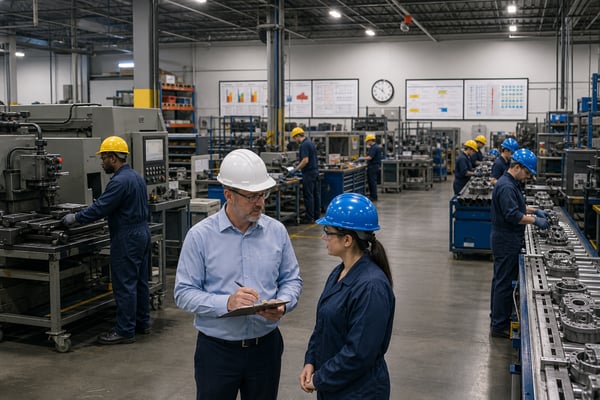
A manufacturing assessment is a structured evaluation of a production facility's operations, quality systems, and management practices. Done well, it identifies specific improvement opportunities, quantifies their impact, and produces an actionable roadmap. Done poorly, it produces a report that nobody reads. This guide covers the 5-step framework we use on every engagement — what to look at, what to ask, and how to turn findings into results.
MTG does not use a pre-set number of days or hours for our assessments. How long it takes to assess the facility depends on the size, complexity, and the level of depth required by the clients. We have conducted assessments in two days and have also conducted two week assessments. Assessment frameworks need to be flexible to meet specific company and factory needs. Factories and companies are like snowflakes: each is unique but share common features.
Let's be clear about something upfront: an assessment is not an audit.
- Audit: Provide official assurance and check whether specific rules or regulations were met.
- Assessment: Identify gaps, understand maturity, and discover opportunities to grow or improve.
An audit might tell you what is wrong but it won't tell you why something is wrong or what you should do about it.
Written by David Collins III, CEO of Manufacturing Transformation Group. Based on hundreds factory assessments across China, Vietnam, Mexico, Europe, and North America.
Why Most Factory Audits Fail
Before we get into the framework, it is worth understanding why most assessment do not drive change.
We have seen hundreds of assessment and audit reports from other firms. The pattern is always the same: 40 pages of observations, a red-yellow-green scorecard, and a list of recommendations that reads like a textbook. The report gets emailed to the leadership team. Everyone agrees the findings are important (and they usually are) yet no one wants to take action.
The problem is not the findings. It is the follow-through. An assessment without an action plan is just industrial tourism. I love touring around a new factory and understanding how they work but that by itself won't produce results. Every finding needs three things: an owner, a deadline, and a follow-up mechanism. If your assessment report does not produce those three outputs for every major finding, it will collect dust.
The second failure mode is surface-level observation. Auditors who spend their time in conference rooms reviewing documents and interviewing managers will produce a polished report that misses what is actually happening on the floor. The best audits are done with a clipboard on the production line, watching operators, timing cycles, and counting defects. If the auditor's shoes are clean at the end of the week, they did not do their job.
The third is middle management resistance. In our experience — particularly in Chinese factories, but frankly everywhere — middle managers are often the biggest barrier to change. They are afraid of what the audit will reveal. They resist suggestions for improvement because change threatens their authority or exposes gaps in their competence. Without strong leadership backing the audit, middle managers will quietly ensure nothing changes.
In China, the owner of a factory that supplies our client can often be the problem. The owner has the same fears that the middle managers might have. They don't want to be told that they are doing anything wrong. It is a pride issue, of course, but also a commercial issue. Factory owners do not want its buyers to know its flaws and use that to demand more price concessions.
The 5-Step Framework
This is the structure we use for a single-site manufacturing assessment. It can be scaled up for larger facilities or multi-site assessments, but the core logic stays the same.
Step 1: Leadership Interviews and Facility Walkthrough
Management Interviews (3-4 hours)
Start with the site leader, then work through the functional heads: operations, quality, maintenance, supply chain, HR. The goal is not to hear their PowerPoint — it is to understand their priorities, their pain points, and what they think the factory's biggest challenges are.
Key questions:
- What are your top three operational challenges right now?
- What KPIs do you track daily? (If the answer is "we review them monthly," that is a finding.)
- When was the last time you lost a customer, and why?
- What does your continuous improvement process look like?
- Where do you think the factory is losing the most money?
Listen for gaps between what management says and what you will see on the floor. The bigger the gap, the bigger the opportunity.
Full Facility Walkthrough (3-4 hours)
Walk every inch of the facility. Not just the production floor — the warehouse, receiving dock, shipping area, maintenance shop, tool crib, break rooms, and the areas they do not want to show you. Those are usually the most revealing.
During the walkthrough, observe:
- Flow: Does material move logically from receiving to shipping, or does it zigzag across the plant?
- 5S / housekeeping: Is the facility organized? Are tools in their designated places? Is there excessive WIP between stations?
- Visual management: Are there production boards at each line? Are they current or weeks old?
- Safety: PPE compliance, machine guarding, emergency exits, chemical storage.
- People: Are operators engaged or standing idle? Is there a supervisor present on the floor?
Take photos of everything. You will reference them in your findings presentation in Step 5.
Steps 2-3: Deep-Dive Process Observation
This is where the real assessment happens. Spend dedicated time on the production floor, observing processes, timing operations, and talking to operators and supervisors. Cover six areas:
1. Production Operations
- Map the production flow from raw material to finished goods
- Time cycle times at each station and compare to standards (if standards exist)
- Identify bottleneck operations — where does WIP pile up?
- Observe changeover processes — how long do they take, and are they standardized?
- Calculate OEE for critical equipment if the factory does not already track it
2. Quality Systems
- Review the process control plan — does one exist, and is it followed?
- Observe in-process inspections — are they happening as documented?
- Review defect data — what are the top defect types, and what is being done about them?
- Check the corrective action process — are root causes identified, or is the factory just containing symptoms?
- Look at customer complaints — how many, how fast are they resolved, and do they recur?
3. Maintenance
- What is the ratio of preventive to reactive maintenance? (World-class is 80/20. Most factories are inverted.)
- How is downtime tracked? By cause category?
- Is there a spare parts inventory, or does every breakdown trigger an emergency purchase?
- Are maintenance schedules posted and followed?
4. Supply Chain and Inventory
- How is incoming material inspected? What is the rejection rate?
- How much raw material and finished goods inventory is on hand? In days of supply?
- Are there stockouts causing production delays?
- How are suppliers measured and managed?
5. Workforce
- Are there standard work instructions at each station?
- Is there a skill matrix showing who is trained on what?
- How are new operators trained? How long does it take to reach full productivity?
- What does the shift handover process look like?
- What is the turnover rate, and what are the top reasons people leave?
6. Management Systems
- Is there a daily management process (morning standup, KPI review, action assignment)?
- How are problems escalated from the floor to management?
- Is there a structured continuous improvement program, or is improvement ad hoc?
- How does the factory track and close corrective actions?
Step 4: Data Analysis and Gap Identification
Step back from the floor, compiling and analyzing what you observed.
Quantify the gaps. Do not just say "changeover times are long." Say "changeover on Line 3 takes 47 minutes vs. a target of 15 minutes, costing approximately 2.1 hours of production per shift." The more specific the finding, the harder it is to ignore.
Prioritize using impact vs. effort. Organize findings into four categories:
- Quick wins (high impact, low effort) — Do these first. They build momentum and credibility.
- Strategic improvements (high impact, high effort) — Plan these as phased projects over 3-6 months.
- Fill-ins (low impact, low effort) — Do these when capacity allows.
- Deprioritize (low impact, high effort) — Acknowledge but do not chase these.
Build the action plan. For every major finding, define: what needs to change, who owns it, what the deadline is, and how you will verify it was done. No finding should leave the assessment without these four elements.
Step 5: Findings Presentation and Action Plan
Present findings to the full leadership team — not just the site leader, but the functional heads who participated in Step 1 interviews. This closes the loop.
Structure the presentation:
- Executive summary — 3-5 key findings and their estimated impact
- Detailed findings by area — with photos, data, and specific examples
- Prioritized action plan — quick wins for the next 30 days, strategic improvements for 90 days
- Recommended KPIs — what to track going forward to measure improvement
- Discussion and alignment — get commitment from each functional owner on their action items
The presentation should not be a surprise. If you found something critical during the assessment, you should have flagged it in real time. This step is about alignment and commitment, not reveals.
What Separates a Good Assessment from a Great One
Talk to operators, not just managers. Managers will tell you what they think you want to hear. Operators will tell you what actually happens. Ask them: "What is the hardest part of your job?" and "What would you fix if you could?" You will get more actionable insight from five minutes with an operator than from an hour-long management presentation. Speak to them without the managers around and do not reveal who said what. You want the operators to be at ease. That is why we use local staff as much as possible. It is always better to speak directly than through a translator.
Watch the night shift. If the factory runs multiple shifts, make sure you observe at least one non-day shift. Quality, safety, and management oversight almost always degrade on nights and weekends. The day shift is the factory's best foot forward. The night shift is the truth.
Follow the scrap. Find the scrap bins and the rework area. Count what is in them. Ask where it came from. This is often the fastest way to identify the factory's biggest quality problem — faster than reviewing any report. Check if the factory has organized scrap bins and rework areas with proper marking and identification.
Check the bathrooms and break rooms. This sounds trivial, but the condition of the employee facilities tells you more about management's attitude toward their workforce than any HR presentation. Factories that invest in their people's basic comfort tend to have lower turnover, higher engagement, and better quality. When I worked in a factory in college, having a nice break area improved my morale. Better than service jobs I had beforehand.
Come back. The assessment is the beginning. Have results, a specific action plan, and deliverables at the end of the assessment that the factory can implement. It is our experience that most of the factories need help to reach their goals.
When to Call in Outside Help
Internal assessments are valuable for ongoing monitoring, but there are situations where an external assessment adds significant value:
- Due diligence: Before acquiring a factory or a company with manufacturing operations, you need an independent assessment of what you are buying.
- Supplier qualification: Before committing volume to a new supplier, assess their operations to verify their capabilities match their claims.
- Turnaround situations: When a factory is underperforming and internal efforts have stalled, an outside perspective can identify blind spots and break through organizational resistance.
- New factory setup: Before production begins, assess the facility, equipment, and processes to catch problems before they become expensive.
- Regulatory or customer requirements: When your customers or regulators require third-party assessments (common in automotive, medical devices, aerospace, and defense).
Need a factory assessment?
Manufacturing Transformation Group conducts factory assessments across China, Vietnam, Mexico, Europe, and North America. Our assessments go beyond checklists — we quantify improvement opportunities, build actionable roadmaps, and stay engaged through implementation. Get in touch to discuss your facility.