


A process control plan is a document that details every production step, its controls, and established quality standards. It is one of the core tools in manufacturing quality management, used to ensure consistent product quality by defining what to check, how often, what tolerance is acceptable, and what action to take when something is out of spec. This guide explains how to fill one out with real examples.
Process control is a vital part of any successful manufacturing process. Although more digital (and AI-powered) tools are on the market now, surprisingly many companies still use paper or spreadsheets. There are even a few that do not have any control plan. Understanding a control plan will help you quickly grasp the manufacturing system and test it against the factory's actual operations.
What is a Process Control Plan?
A process control plan is a document that sets out the quality system components necessary to deliver high-quality products. It is one of the 'core tools' mentioned in the IATF 16949 standard. The IATF 16949 is the technical specification for the automotive industry. Broadly speaking, automotive industry guidelines are a good benchmark for other industries, as the industry is highly competitive and required by both statute and the market to maintain high-quality standards.
A good quality management system is crucial to maintaining consistent product quality, and the control plan outlines the details and steps needed to achieve that standard.
A process control plan looks more or less like this:
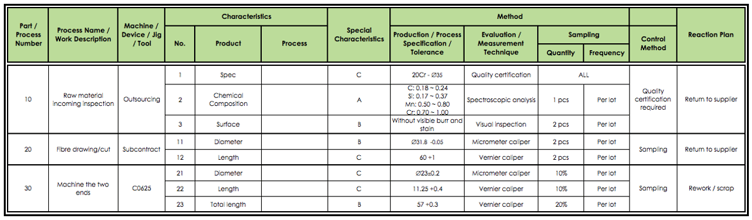
It lists all production processes (if possible, including those of sub-suppliers). If you are an importer and can't spend much time working with your suppliers, the minimum you need is a quality control plan that defines expectations for the finished product. Do not take a passive role in the quality control plan. Provide one yourself or, at a minimum, provide feedback and demand details from the supplier.
Why is a Process Control Plan Important?
A process control plan can help enhance operational efficiency, minimize risk, and most importantly, ensure consistent product quality. This strategic plan acts as a blueprint for quality management, outlining which processes need to be controlled, how they will be monitored, and how the team will respond when deviations occur. It is crucial because it creates a structured approach to managing variability in manufacturing processes, which can directly impact a business's bottom line.
Understanding the importance of a process control plan brings us to its key benefits:
- Clarity and Consistency: It ensures each process area knows what it needs to do to maintain quality, and they understand how their work is evaluated. This leads to consistent production, lower error rates, and greater efficiency.
- System Evaluation and Improvement: The plan allows the organisation to evaluate the existing quality system and identify potential gaps. This information can then be used by the quality manager to draw up a process improvement plan.
- Audit Readiness: With a defined control plan in place, top management can establish an audit schedule that verifies compliance with the plan. This readiness reduces the stress and potential issues associated with unexpected audits.
- Customer Confidence: A well-implemented control plan enhances customer confidence by demonstrating the organization’s ability to consistently deliver quality products. This could lead to increased customer loyalty, repeat business, and a stronger market position.
Need help building a process control plan for your factory?
Manufacturing Transformation Group has helped manufacturers across China, North America, Mexico, and Vietnam implement quality systems that stick. Book a free consultation to discuss your operation.
Example of a Process Control Plan
Now that we understand why a process control plan matters to your manufacturing operation, let's look at how it works. In the short video below, let's walk through a comprehensive control plan we previously used for an electronic product. The video is older, but the structure and information haven't changed.
Let’s look at an example of this document in further detail. To break this down, we've split the plan into two sections: the left side and the right side. We'll go over what items each side covers.
The Left Side of the Plan - Process Steps
The columns on the left list the process steps or the products (usually purchased from external suppliers) to be controlled:
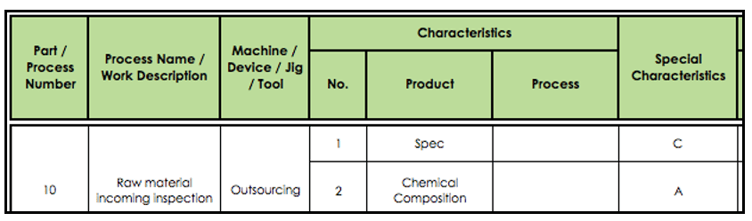
The Chart Headers in This Section Have the Following Meanings:
- Part / Process Number: An identifier for the process step
- Process Name / Work Description: A description of the process or operation
- Machine / Device / Jig / Tool: Identifying what is used to process the part
- Characteristics: Identifying the steps within the process and the process description
- Special Characteristics: The critical features of a process that require extra attention to ensure functionality, performance or safety
Here are typical code letters for special characteristics:
- A = Critical to Quality (CTQ), need to have very specific actions taken
- B = Functional dimensions and, therefore, tolerances need to be monitored
- C = Need monitoring but calls for fewer resources
Frequently Asked Questions About This Section:
Why indicate that a process step is CTQ?
Any process step that is CTQ means it needs to be controlled more tightly.
How do you know what issues to look out for?
You can follow the process steps and think: "What controls are needed here?". A process FMEA will help and is a useful tool to implement before working on a process control plan.
Why include the products from suppliers?
It's imperative to check the quality of incoming material and your in-house processes.
Should we do this for every SKU we make?
It makes more sense to have 1 control plan per product family (as long as the products within the family share most of the process steps). Too many control plans are unwieldy and make it less likely that operators will use them.
The Right Side of the Plan - Standards, Tolerances, and Control Method
The columns on the right include the standard and the tolerance, the control method and sampling, and the reaction plan (i.e. what to do in case deviations are detected:
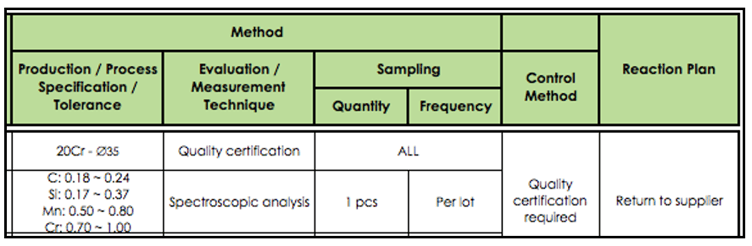
The Chart Headers in This Section Have the Following Meanings:
- Method - Production / Process Specification / Tolerance: Indicating the specification and tolerance the process needs to meet
- Method - Evaluation / Measurement Technique: Indicates what is used to measure the process output or dimension
- Method - Sampling: Indicates the quantity and frequency
- Method - Control Method: Identifies how the process is controlled
- Reaction Plan: If the process is identified to be out of specification, the actions to be taken
Frequently Asked Questions About This Section
Does QC work take a lot of time?
QC work does take a considerable amount of time. However, the earlier you catch an issue, the less inspection, sorting, and rework you need to do, and the less material you need to scrap. There are methods to reduce QC time.
Do we need to hire many inspectors?
It's not necessary. Add this to your production operators’ work routine (e.g. ‘measure 1 piece every time the small container is full '). This will let you eliminate most of your end-of-line QC staff.
Are there tips to avoid spending too much time on this?
The best way is to mistake-proof your processes without adding work for operators.
Process Control Plan Adaptation in Different Scenarios
Process control plans are crucial in most industries. Here are some examples of the automotive, pharmaceutical, and electronics manufacturing industries:
The Automotive Industry
The automotive industry faces many challenges during manufacturing. At this stage, control plans help monitor parameters like welding temperature, pressure, and duration to ensure product integrity. They can also regulate assembly-line operations, prevent faulty parts, and maintain adherence to quality and safety standards.
Failure to follow a plan will cause systemic problems throughout manufacturing. An example from a previous project involved welding a gas tank. The welders followed their experience rather than a plan with clear temperature, duration, and pressure parameters. The results were occasional gas tanks that were not properly sealed. The problem was discovered only after the product shipped, and the client often had to air-ship replacements. The welders were capable but failed to follow the control plan, and the failures caused the client millions per year.
The Pharmaceutical Industry
In the pharmaceutical sector, control plans regulate critical elements such as tablet composition, tablet pressing conditions, and packaging quality checks. These plans ensure consistent dosage, potency, and purity while maintaining compliance with regulatory standards set by agencies such as the FDA.
Manufacturing pharmaceutical products at scale and failure to follow plans can often mean entire batches need to be scrapped. MTG is involved in a project now with a pharma company. The company is losing money from failed batches as a result of control plans that were not well structured.
The Electronics Industry
In the electronics industry, control plans govern aspects like the concentration and temperature during the etching process in printed circuit board manufacturing. They also manage the quality of soldering, assembly operations, and testing procedures, reducing the likelihood of defects and ensuring the end products meet performance specifications.
Years ago, MTG worked on a niche electronics product that consistently failed to meet quality standards. Our team found that the supplier was skipping steps in the manufacturing process that seemed, to them, unnecessary and slowed down productivity. MTG worked with the client and the factory to design a new plan that would streamline the manufacturing while maintaining the same level of control.
Adapting Process Control Plans for Other Areas of Manufacturing
Quality professionals typically maintain a control plan. They can also use it for preventive maintenance of production equipment.
Here is an example of a preventive maintenance plan. Most of the columns can be the same and can be turned into a checklist for maintenance technicians.
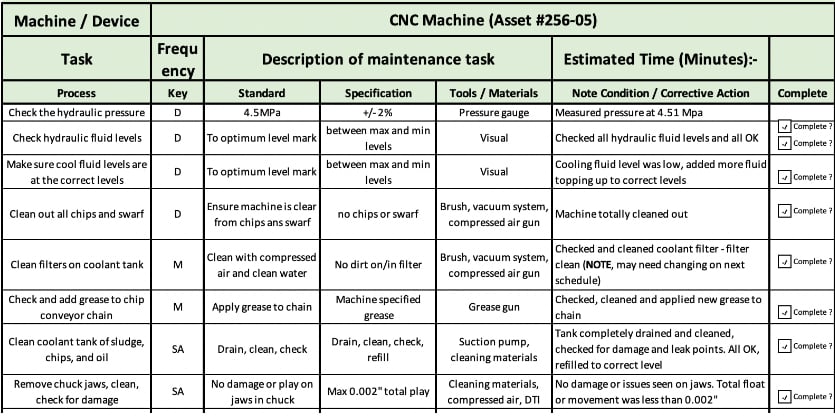
The Chart Headers Have the Following Meanings:
- Task: Identifies the maintenance activities for optimal equipment functioning
- Frequency: Indicates how often maintenance tasks should be performed.
- Description of maintenance task - Standard: Indicates details and requirements for performing each task effectively and consistently.
- Description of maintenance task - Specification: Outlines the specific criteria to be met while performing each maintenance task.
- Description of maintenance task - Tools / Materials: Indicates the required tools needed to perform each maintenance task effectively and safely.
- Estimated time - Note condition / Corrective action: Indicates the approximate time needed to complete each maintenance task and documents any observed issues and the corrective actions to be taken.
Quality professionals typically maintain a control plan, which can also support preventive maintenance for production equipment. For example, in the automotive industry, the control plan monitors parameters like welding temperature, pressure, and duration and can also serve as a preventive maintenance checklist for equipment like CNC machines and assembly lines.
CNC Machines
Process control plans help prevent common setup and maintenance issues on CNC machines. In this context, the process control plan ensures the machines operate within specified parameters, such as speed, feed rate, and depth of cut. Preventive maintenance involves regular inspection, lubrication, and calibration of the machine components, helping to prevent breakdowns and maintain accuracy.
Assembly Lines
Assembly lines bring on a multitude of advantages, but a control plan will help monitor the efficiency and quality of each production. Here, the control plan monitors the efficiency and quality of each production step, while preventive maintenance keeps equipment like conveyor belts and robotic arms running through regular inspections, adjustments, and part replacements.
By merging process control and preventive maintenance, organizations can maintain high-quality standards, improve equipment reliability, and reduce the risk of defects. If you want to read more about preventive maintenance, here's a blog about preventive maintenance checklists for the automotive industry.
Process control plans are critical tools for any organization that wants to maintain high-quality standards. Few manufacturers—whether in China, North America, Mexico, or Vietnam—have done the hard work of developing and keeping one updated, and they are among the top 1% in their industries. They provide a comprehensive overview of the processes and products involved, along with expectations for each. By establishing a clear set of criteria and expectations, organizations can implement effective quality control measures and reduce the risk of defective products entering the market. Process control plans also connect directly to OEE improvement—equipment that drifts produces parts that drift—and to preventive maintenance, where control plans can monitor equipment condition alongside product quality.
Related: If your supplier resists implementing these improvements, there's usually a reason. Read Why Your Supplier Does Not Want Improvements — and What to Do About It
Ready to implement process control in your factory?
Manufacturing Transformation Group (MTG) has been helping manufacturers build quality systems on the factory floor since 2012 — across China, North America, Mexico, and Vietnam. Whether you're starting from scratch or improving an existing system, we can help.