

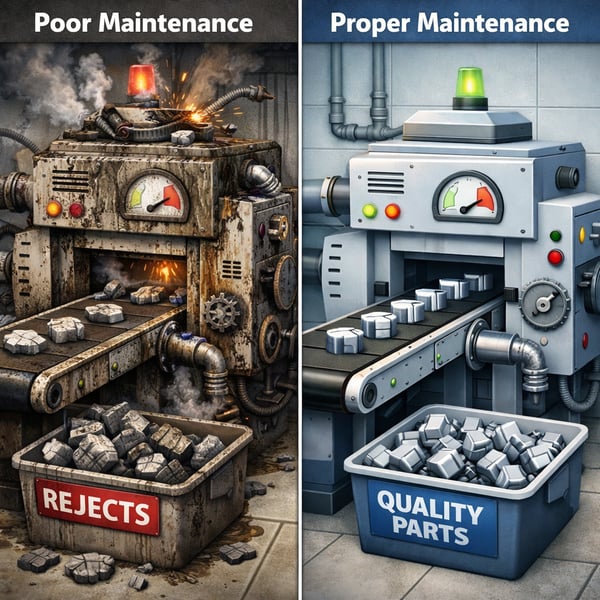
Key Takeaways
- Every $1 spent on preventive maintenance returns more than $5 in avoided downtime and extended equipment life
- The average manufacturing facility loses $260,000 per hour to unplanned downtime
- Despite 88% of companies claiming a PM strategy, nearly half of all maintenance work is still reactive
- The biggest barrier isn't technology — it's discipline, documentation, and operator involvement
Unplanned downtime costs the average manufacturing facility $260,000 per hour. Fortune 500 manufacturers collectively lose $1.5 trillion annually to it. And yet, nearly half of all maintenance activities in manufacturing remain reactive — fixing things after they break rather than preventing the break in the first place.
The business case for preventive maintenance has never been stronger. The data is clear: every dollar invested in PM returns more than $5 in reduced downtime, extended asset life, and avoided emergency repairs. That's a 545% ROI.
So why do so many factories still run to failure?
Because implementing preventive maintenance isn't a technology problem — it's a systems problem. And systems problems require discipline on the floor, not just software in the office.
Years ago, my father told me a story of when he was the plant manager for Chrysler. His boss would often keep maintenance costs low so he could show greater cash on hand throughout the year. Looks good on a balance sheet but not practical when it comes to operations. Inadequate maintenance led to more delays, more rework, and more production failures. These costs were cumulative rather than immediate so were not as readily accounted for on balance sheets. When confronted with these issues, my father told the maintenance manager to fix all the existing issues and institute scheduled down time for maintenance even when everything was fine. It was expensive at first but afterwards overall maintenance costs were lower and output was greatly improved. The higher-ups, who did not get involved in the details, were amazed, but the answer was very simple.
The Real Cost of "We'll Fix It When It Breaks"
Reactive maintenance feels cheaper in the moment. No planning overhead. No scheduled downtime for inspections. No spare parts inventory to manage. Out of sight and out of mind. But the math doesn't work:
- Emergency repairs cost 3-9x more than planned maintenance for the same equipment
- Unplanned downtime cascades. When one machine goes down unexpectedly, the entire line stops — operators stand idle, downstream stations starve, and delivery commitments slip
- Quality degrades before failure. A bearing that's wearing isn't just going to seize — it's producing vibration that degrades tolerances on every part it touches. By the time it breaks, you've already shipped marginal product
- Safety incidents increase. Equipment that fails unpredictably creates dangerous conditions — flying debris, unexpected movements, loss of containment
We've seen factories in China where a single unplanned press failure shut down production for three days — not because the repair was complex, but because the spare part had to be air-freighted from Germany. A $200 bearing became a $180,000 problem when you add lost production, air freight, expedited overtime to catch up, and a late delivery penalty from the customer. The situation occurs everywhere but it is significantly more common in China. It is not uncommon for a factory to run machines to the breaking point and just buy new ones. Penny wise and pound foolish behavior is common as many owners do not really understand manufacturing. See our previous blog for more examples.
What a Real Preventive Maintenance Program Looks Like
Preventive maintenance isn't just changing oil on a schedule (though you should definitely do that). A program that actually works includes five components:
1. Equipment Criticality Ranking
Not every machine deserves the same level of attention. Rank your equipment by impact: if this machine goes down, how much production do you lose? How much does it cost? Is there a backup? The answer determines whether a machine gets daily inspection, weekly checks, or monthly planned maintenance.
2. Documented Maintenance Plans with Checklists
Every piece of critical equipment needs a written maintenance plan: what to check, how often, what tolerance is acceptable, and what action to take when something is out of spec. This isn't optional — it's the foundation. Without it, maintenance quality depends on who's working that shift. We've published detailed guidance on building preventive maintenance checklists including downloadable examples.
3. Operator-Level Basic Care (Autonomous Maintenance)
The operators who run the equipment 8-12 hours a day are your first line of defense. They notice the unusual sound, the slight vibration, the temperature change. Total Productive Maintenance (TPM) puts basic inspection and cleaning tasks in the hands of operators — not because you're asking them to be maintenance techs, but because they're the ones closest to the machine when something starts to drift. I think about it how I think about the operation of my car. Others might not notice but as the primary driver, I know when something does not feel right.
4. Spare Parts Strategy
The best maintenance plan in the world is useless if the replacement part has a 6-week lead time. Identify critical spares for your highest-priority equipment, establish min/max inventory levels, and build relationships with suppliers who can expedite. The cost of holding spare parts is trivial compared to the cost of a line down waiting for a delivery. Many complex machines will fail if an inexpensive component is missing.
5. Data Collection and Trend Analysis
Start simple: track every breakdown by machine, cause, and duration. After 3-6 months, patterns emerge. Maybe 70% of your unplanned downtime comes from three machines. Maybe bearing failures always happen in summer when ambient temperature rises. These patterns tell you exactly where to invest your prevention effort for maximum return. The manufacturer of the machine will provide guidance but it is useful to have your own records to supplement those.
Need help building a preventive maintenance system?
Manufacturing Transformation Group has implemented PM programs in factories across China, North America, Mexico, and Vietnam — from basic checklist systems to full TPM deployment. Book a free consultation to discuss your operation.
Why Most PM Programs Fail
The technology exists. The ROI is proven. So why do so many programs stall or revert to reactive maintenance within 12 months?
Failure 1: No management commitment
PM requires scheduled downtime for inspection and maintenance. That means voluntarily taking a machine offline when it's running. Production managers under pressure to hit daily targets will always resist this — unless leadership makes it non-negotiable. Without top-down commitment, PM loses to short-term production pressure every time.
Failure 2: Too ambitious at launch
Trying to implement PM across every machine simultaneously overwhelms the maintenance team and creates a mountain of paperwork that nobody sustains. Start with your top 5 most critical machines. Build the discipline. Prove the results. Then expand. Crawl, walk, run. Good maintenance is a culture.
Failure 3: No operator involvement
If maintenance is purely a "maintenance department" responsibility, you've cut yourself off from the people who know the equipment best. Operators who feel ownership over their machines catch problems earlier. Operators who feel like they just push buttons wait for someone else to notice. Operators should be responsible for basic maintenance and cleanliness of their machines.
Failure 4: Tracking compliance but not results
Many PM programs measure whether checklists were completed — not whether unplanned downtime actually decreased. If your MTBF (Mean Time Between Failures) isn't improving, your PM program isn't working, regardless of how many checkboxes got ticked.
Getting Started: The First 90 Days
If you don't have a PM program today — or your current one isn't delivering results — here's a practical 90-day roadmap:
Days 1-30: Foundation
- Rank all equipment by criticality (impact of failure × frequency of failure)
- Identify your top 5 problem machines from breakdown data
- Write basic maintenance checklists for those 5 machines
- Assign ownership — who is responsible for each machine's PM compliance?
Days 31-60: Implementation
- Train operators on basic autonomous maintenance tasks (cleaning, inspection, lubrication)
- Schedule first planned maintenance windows — even if it's just 30 minutes per week per machine
- Begin tracking all breakdowns: machine, cause, duration, cost
- Order critical spare parts for top 5 machines
Days 61-90: Measurement and Expansion
- Compare unplanned downtime to the 60 days before implementation — you should see improvement
- Identify which of the 5 machines responded best and why
- Expand the program to the next 5 machines
- Present results to leadership with dollar figures — this builds ongoing support
The Connection to Everything Else
Preventive maintenance doesn't exist in isolation. It connects directly to:
- Process control — equipment that drifts produces parts that drift
- Visual management — maintenance status boards make equipment health visible to everyone
- Standard work — maintenance checklists ARE standard work for your maintenance team
- Workforce development — PM programs require trained operators who understand their equipment, not just how to operate it
When we run factory turnarounds, preventive maintenance is almost always one of the first levers we pull — because it delivers measurable results within weeks while building the discipline foundation for everything else.
It is also vital for operator safety. Well maintained machinery is safer machinery. Few things will slow down production faster than an injury.
How MTG Can Help
Manufacturing Transformation Group has built preventive maintenance systems in factories across four continents — from basic checklist programs for small operations to full TPM deployments for complex facilities. We know what works on the floor because we implement it on the floor, side by side with your maintenance team and operators.
Whether you're starting from scratch or trying to revive a PM program that stalled, we can help you build a system that sustains itself after we leave.
Losing money to unplanned downtime?
We've helped manufacturers cut unplanned downtime by 50% or more with practical PM systems that operators actually follow. Let's talk about what's possible in your plant.