

Key Takeaways
- The USMCA review starts July 1 — two weeks from today
- A clean extension now appears unlikely. Negotiations are already proceeding bilaterally (US-Mexico), with Canada on the outside
- CSIS identifies four likely scenarios — from "painful extension" to annual reviews to bilateral fragmentation
- If you manufacture in or source from Mexico, the next 90 days will determine your trade framework for the next decade
In April, we wrote about the USMCA review when it was 90 days away. We outlined the three areas to watch — automotive rules of origin, EV supply chains, and Chinese investment in Mexico — and recommended that manufacturers map their supply chains, strengthen documentation, and build scenario plans.
Two weeks out, the picture has changed. Here's what's different — and what you should be doing right now.
What's Changed Since April
A clean extension is off the table
In April, the consensus was that the USMCA would be extended with modifications. That's still the most likely outcome, but the timeline has shifted. CSIS now describes the base case as a "painful extension" — negotiations stretching into late 2026 or beyond, with costly concessions on rules of origin and market access. A simple handshake on July 1 is not happening.
The review is already bilateral, not trilateral
The US and Mexico concluded their first negotiation round in late May, covering automotive rules of origin, steel and aluminum trade, and economic security. Canada has not been at the table. The US-Canada relationship remains strained, with ongoing tariff friction.
This matters because a bilateral approach could fracture the regional coherence that makes North American supply chains work. If the US negotiates separate terms with Mexico and Canada, manufacturers with trilateral supply chains face a more complex compliance environment.
Four scenarios are now in play
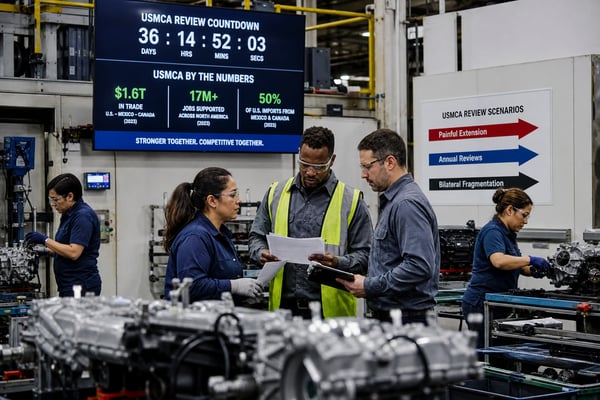
CSIS outlines four possible outcomes:
| Scenario | What It Means | Impact on Manufacturers |
|---|---|---|
| Painful Extension | Deal reached but with significant concessions on rules of origin and market access | Tighter content thresholds, more audits, higher compliance costs — but 16 years of stability |
| Serial Annual Reviews | No deal by July 1; agreement enters yearly renewal cycles through 2036 | USMCA stays active but under permanent uncertainty — discourages long-term investment |
| Bilateral Fragmentation | Separate US-Mexico and US-Canada deals replace the trilateral framework | Fractures regional supply chains; dual compliance burden; weaker bargaining position for all |
| Withdrawal Threat | Used as a negotiating tactic rather than a real outcome | Creates short-term market volatility and planning paralysis |
The "painful extension" remains the most likely outcome. But manufacturers who are only planning for that scenario are exposed if the review slides into annual reviews or bilateral fragmentation.
Based on our experience, we believe that "painful extension" or "serial annual reviews" are the more likely outcomes. Both options are consistent with actions taken by the current US administration. While there is pressure to take a more hardline approach, cooler heads are likely to prevail and take one of the easier options. The annual reviews may be painful but it is easier to kick the can down the road to deal with later. The painful extension may be the solution that would serve the administration's political goals.
While there are disagreements with Canada, business leaders in the US are unlikely to want to alienate the Canada further and endanger the massive amount of bilateral trade especially in a time of higher fuel prices. Canada is not considered as much of "threat" as Mexico so the differences are less important.
Mexico (and Canada for that matter) are less likely to take withdrawal threat seriously due to repeated instances of TACO (Trump Always Chickens Out) in trade negotiations. A withdrawal at this point would likely make economic performance worse for all countries; something that neither country is interested in dealing with.
Chinese content scrutiny has intensified
Since our April post, we published a deep dive on how China has become the factory to the factories — exporting components that get assembled in Mexico and Vietnam and shipped to the US under preferential trade terms. One-third of Mexico's export value to the US is Chinese value-added content. We have seen that firsthand with steel and electronic components.
This is now explicitly on the negotiating table. Manufacturers with significant Chinese component inputs in their Mexico-based supply chains face the highest compliance risk from this review.
Is your supply chain ready for what July brings?
Manufacturing Transformation Group helps manufacturers map their full tier structure, quantify USMCA exposure, and build operations that work regardless of which scenario materializes. Book a free consultation before July 1.
What to Do in the Next Two Weeks
If you haven't acted on the recommendations from our April post, the window is closing. Here's what's still actionable:
1. Audit your Mexican supply chain for Chinese content
This is the single highest-risk area. If your Mexico-based suppliers use Chinese components, Chinese machinery, or have Chinese ownership, document it now. Know your exposure before an auditor finds it for you.
2. Build scenario plans for at least two outcomes
Don't plan for just the extension. Model what annual reviews would mean for your investment decisions and what bilateral fragmentation would do to your trilateral supply chains. The cost of planning for two scenarios is small. The cost of being caught by the wrong one is enormous.
3. Talk to your suppliers — today
If rules of origin tighten, your suppliers need lead time to adjust sourcing or documentation. The manufacturers who communicated early will have options. The ones who wait will be scrambling in August.
4. Document your content calculations
Enforcement is increasing. Verify your tariff classifications and supplier declarations. If an audit finds that your content calculations don't hold up, you're facing retroactive duties — and that risk goes up significantly under any of the four scenarios. We have seen deals fail because the content of Chinese material (especially steel) was too high to qualify and eliminated the advantage of manufacturing in Mexico over China.
How MTG Can Help
We've been helping manufacturers navigate this exact situation across Mexico, China, Vietnam, and North America since 2012. Whether you need a full supply chain mapping, a USMCA compliance audit, or help building operations that work regardless of the trade framework — we do it on the ground, with your team.
July 1 is two weeks away.
Don't wait for the outcome to start preparing. The manufacturers who act now will have options. The ones who wait will be reacting.