

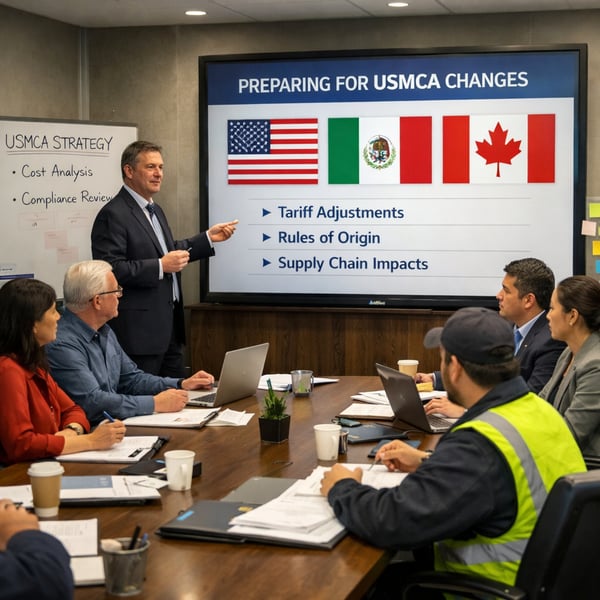
The first formal joint review of the United States-Mexico-Canada Agreement (USMCA) begins on July 1, 2026. If you manufacture in Mexico, source from Mexican suppliers, or have nearshored production under USMCA's duty-free framework — this review directly affects your cost structure.
The most likely outcome is that the agreement gets extended. But "extended" doesn't mean "unchanged." And the 90 days between now and the review are your window to prepare.
Here's what's at stake and what to do about it.
What Is the USMCA Review?
Every six years, the U.S., Canada, and Mexico formally review the agreement. If all three countries confirm they want to continue, the USMCA extends for another 16 years, with the next review in 2032.
If any country declines to extend, the process shifts to annual reviews — creating a 10-year countdown during which the three governments must resolve their differences or the agreement expires entirely in 2036.
The U.S. Trade Representative opened its public comment period in September 2025 and received over 1,500 written comments and 170 hearing requests — enough to expand from one hearing day to three. That level of engagement tells you how seriously industry is taking this.
What Could Change
Three areas are drawing the most attention:
1. Automotive rules of origin
The current USMCA requires 75% regional value content for vehicles to qualify for duty-free treatment. The U.S. is expected to push for even higher thresholds, particularly in steel, aluminum, and automotive components. If your products include auto parts or you supply into the automotive chain, content calculations could shift — and with them, your duty-free status.
2. Electric vehicles and battery supply chains
EVs and battery manufacturing weren't a major factor during the original 2018 negotiations. Now they're central to North American industrial policy. Expect new provisions around EV supply chain content and sourcing requirements. If you're in this space, the rules that apply today may not be the rules that apply in Q4.
However, the landscape has shifted dramatically since the $7,500 federal EV tax credit expired on September 30, 2025. US EV sales are projected to drop by as much as 25% in the first half of 2026, and automakers have collectively absorbed over $65 billion in writedowns — Stellantis ($27B), Ford ($19.5B), GM ($7.6B). GM has already cut shifts and laid off workers at its Spring Hill, Tennessee plant. Some battery manufacturers are repurposing EV battery plants for data center and utility markets as they search for alternative revenue streams.
This creates a paradox for the USMCA review: the subsidy-driven incentive to build North American EV supply chains has weakened, but tariff-driven pressure to regionalize production remains. The review may still tighten EV-related rules of origin — but with domestic EV investment slowing, fewer manufacturers may be positioned to benefit from those rules. If you're in the EV supply chain, the math is changing from two directions at once.
3. China's investment footprint in Mexico
U.S. stakeholders are raising concerns about Chinese companies establishing manufacturing operations in Mexico to access USMCA benefits. If you're sourcing from Mexico-based suppliers with Chinese ownership or significant Chinese component inputs, this scrutiny could affect your compliance status.
What Manufacturers Should Do in the Next 90 Days
Concerned about your USMCA exposure?
Manufacturing Transformation Group helps manufacturers map supply chains, model tariff scenarios, and build operations that work regardless of what July brings. Book a free consultation to discuss your operation.
Map your supply chain to the component level.
This isn't just about knowing your Tier 1 suppliers. You need to understand where your materials originate, how they cross borders, and what content calculations apply. If you can't trace the origin of your key inputs, you can't guarantee your USMCA qualification.
Strengthen your documentation.
Review your supplier declarations and confirm your tariff classifications. Enforcement is increasing — the days of relying on supplier self-declarations without verification are over. If an audit finds that your content calculations don't hold up, you're looking at retroactive duties.
Build scenario plans.
Prepare for three outcomes:
- Renewal with no changes — business as usual, but don't assume this
- Renewal with tighter rules of origin — model the cost impact of higher content thresholds on your products. If USMCA benefits were suspended, manufacturers would face potential return to WTO/MFN tariffs averaging around 3.2%, but up to 25% for some light trucks
- Extended negotiation — if the review shifts to annual reviews, expect 12-18 months of uncertainty that affects investment decisions
Talk to your suppliers and logistics partners now.
Don't wait for July. If rules of origin tighten, your suppliers need lead time to adjust sourcing or documentation. The manufacturers who communicate early will have options. The ones who wait will be scrambling.
The Bigger Picture
The USMCA review is happening against a backdrop of significant trade realignment. Tariffs on Chinese goods remain above 30%. The ISM Manufacturing PMI just came in at 52.7 for March — the third consecutive month of expansion — signaling that domestic manufacturing momentum is real. Nearshoring to Mexico continues to accelerate, with FDI into Mexico's manufacturing sector up 10% year-over-year in 2025.
All of this makes the USMCA more important, not less. The agreement is the foundation that makes Mexico a viable nearshoring destination. If that foundation shifts, the math changes for every manufacturer operating across the border.
The consensus among trade analysts is that the USMCA will be extended — but with modifications. The question isn't whether the agreement survives. It's whether your supply chain is positioned for whatever version comes next.
How MTG Can Help
Manufacturing Transformation Group has been helping manufacturers set up and optimize operations across Mexico, China, Vietnam, and North America since 2012. We've managed factory relocations, built supply chains from scratch, and helped companies navigate exactly this kind of regulatory uncertainty.
If you're evaluating your USMCA exposure or considering nearshoring production to Mexico, we can help you map your supply chain, model the scenarios, and build an operations plan that works regardless of what July brings.
Is your supply chain ready for the USMCA review?
We'll help you map your exposure, model the scenarios, and build an operations plan that works regardless of what July brings.