

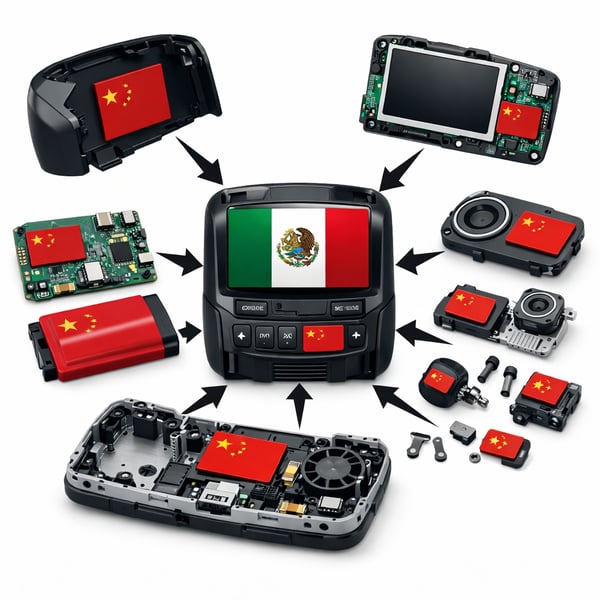
Companies say they have diversified away from China. But look deeper and many of their alternative suppliers in Vietnam, Mexico, and India are still sourcing raw materials, components, and tooling from Chinese factories. China has become the factory to the factories — and true supply chain diversification is harder than it appears.
China is shifting from exporting finished goods to exporting components — becoming the supplier behind the suppliers. If your "diversified" supply chain still depends on Chinese components, tooling, and machinery at Tiers 2-4, your risk hasn't decreased. It's just harder to see.
Key Takeaways
- China's consumer goods exports fell 2% while intermediate goods exports rose 9% — China is selling fewer finished products and more components
- One-third of the value of Mexico's exports to the US is Chinese value-added content
- China accounted for 28.3% of all new foreign projects in Vietnam in 2024 — the highest of any country
- If your "diversified" supply chain still depends on Chinese components, tooling, and machinery at Tiers 2-4, you haven't reduced your China risk — you've hidden it
There's a story the manufacturing world keeps telling itself: we're moving out of China. Reshoring. Nearshoring. China+1. The tariffs worked — we've diversified.
The data and MTG's experiences tell a different story.
US imports from China are down. That part is true. But China's consumer goods exports fell just 2% while its intermediate goods exports rose 9%. ASEAN exports to the US grew 14% — more than double the global average. Those products are assembled in Vietnam, Thailand, Indonesia, and Mexico. But the components inside them? Processors, batteries, industrial machinery, precision tooling — still made in China.
As McKinsey's Jeongmin Seong put it: "We may buy fewer 'Made in China' goods going forward, but more products will have internal components manufactured in China."
China hasn't lost its role in global manufacturing. It's changed the role it plays. It has gone from being the factory to being the factory to the factories.
It is not a surprising development. Manufacturing capacity in new locations cannot be created overnight. China developed the infrastructure over the course of 40 years. The process cannot reverse itself in 13 months (if counted from "Liberation Day"). We have consistently told clients that a move from China to Chinese supplied manufacturers in 3rd countries was inevitable.
What "Factory to the Factories" Actually Looks Like
Here's what we see when we walk into factories across Vietnam, Mexico, and Southeast Asia:
Chinese machinery on the floor. The injection molding machines, the CNC equipment, the packaging lines — a significant share of it is manufactured in China. When it breaks, the spare parts come from China. When it needs to be calibrated, the tech support calls go to China. We often advise companies to use Chinese machinery with proper oversight to ensure quality and capacity.
Chinese components in the product. The final assembly happens in Vietnam or Mexico, but the PCBs, the battery cells, the precision-machined sub-assemblies, the specialty chemicals — they arrive in containers from Shenzhen, Dongguan, or Ningbo. The bill of materials still traces back to Chinese suppliers at Tiers 2, 3, and 4.
Chinese capital behind the operation. China accounted for 28.3% of all new foreign projects in Vietnam in 2024 — the highest of any country, with over 950 new projects launched in a single year. Cumulative Chinese FDI in Vietnam has reached roughly $30.8 billion. Many of the "Vietnamese" factories that Western companies source from are Chinese-owned, Chinese-managed, and Chinese-financed. We inform our clients of this upfront. It is common that one of every two to three factories that we investigate and assess for our clients is Chinese-owned and managed. Last year, for example, we conducted training in Vietnam for Chinese managers in Chinese.
The same pattern in Mexico. Chinese-made components are imported into Mexico, assembled into finished goods in newly established factories, and exported to the US under USMCA's favorable terms. Approximately one-third of the value of Mexico's exports to the US comprises Chinese value-added content. Between 2013 and 2023, the top sectors for Chinese investment in Mexico were electronic components, automotive components, communications, and industrial equipment. Our contacts in Monterrey and Juarez confirm this situation.
Why This Matters for Your Business
If you moved final assembly out of China but didn't map your full supplier tier structure, you may have done three things:
- Added cost. You're now paying for an additional logistics leg — components ship from China to your assembly country, then finished goods ship to the US. That's more freight, more handling, more lead time, and more opportunities for disruption.
- Added complexity without reducing risk. Your tariff exposure on the finished good may be lower, but if a disruption hits Chinese component production — a port closure, an export restriction, a COVID-style lockdown — your Vietnam or Mexico line stops just the same.
- Created a false sense of security. Leadership sees "assembled in Mexico" on the invoice and believes they've diversified. The procurement team knows the BOM still traces to China. Nobody has reconciled the two.
How exposed is your supply chain?
Manufacturing Transformation Group helps manufacturers map their full tier structure — not just Tier 1 — to identify hidden Chinese dependencies and build real diversification. Book a free consultation to discuss your situation.
What Real Diversification Looks Like
Moving assembly is step one. It's the easy part. Real diversification means addressing the component and capability dependencies underneath. It requires the kind of deep understanding of Chinese manufacturing that only comes from years on the ground.
Map your full BOM to country of origin
Not just where your Tier 1 supplier is located — where their components come from, where the raw materials originate, and where the tooling was made. We've published a detailed look at supplier engagement challenges for manufacturers trying to get this visibility. Many suppliers resist sharing this information — but without it, you're managing risk blindfolded.
Qualify alternative component sources — before you need them
Run first articles and PPAPs with non-Chinese component suppliers now. Don't wait for a disruption to discover that your Vietnamese assembler's entire BOM traces back to three factories in Guangdong. The qualification process takes months. Start today. If you don't know where your components are coming from, it is almost certainly from China.
Own your tooling
If your tooling sits in a Chinese supplier's factory and you don't own it, you can't move production without starting from scratch. This is one of the most common traps we see — companies that want to diversify but can't because their molds, dies, and fixtures are held by the incumbent supplier. MTG sees this all the time. Don't just own your tooling; have a plan to remove it if need be. We had a client that owned its tooling but was stuck when it came time to move.
Evaluate true landed cost — not unit price
A component that's 15% cheaper from China but adds 6 weeks of lead time, tariff exposure, and a single-source dependency may not be cheaper at all when you calculate the total cost of risk. Factor in tariffs, freight, inventory carrying cost, quality risk, and management overhead. Then compare.
Build regional supply chain capability
The long-term answer isn't just finding alternative suppliers — it's building the manufacturing ecosystem in your target region. That means investing in supplier development, helping local suppliers build capability, and accepting that it takes time to replicate what China built over 30 years. Bath and Body Works built their own ecosystem to support manufacturing operations. It was not easy or quick but it was effective.
The USMCA Factor
This issue is about to get more urgent. The USMCA review begins July 1, and one of the key areas of scrutiny is Chinese investment in Mexico — specifically, companies using Mexican assembly as a pass-through to access USMCA duty-free treatment for goods with significant Chinese content.
If your Mexico-based supply chain includes suppliers with Chinese ownership or significant Chinese component inputs, your USMCA compliance could be at risk. The time to audit this is now, not after the review changes the rules.
What We See on the Ground
We've operated inside factories across China, Vietnam, Mexico, and North America since 2012. The shift from "Made in China" to "assembled elsewhere with Chinese components" is the expected result of rapid tariff implementation without a long-term industrial strategy. It is not if the situation is bad or good but a question about how companies react.
Chinese components are essential for a vast number of manufactured products. You can see that in how the tariffs are hurting American manufacturing. For many products, there's no viable alternative at comparable quality and cost — at least not yet. The question is whether you know where your Chinese dependencies are, whether you've quantified the risk, and whether you have a plan for when — not if — those dependencies get tested.
How MTG Can Help
Manufacturing Transformation Group helps manufacturers see what's actually in their supply chain — not what's on the invoice. We map tier structures, identify concentration risk, evaluate alternative sources, and build transition plans that work in the real world.
Whether you're sourcing from China, assembling in Vietnam, manufacturing in Mexico, or reshoring to the US — we've been on the ground in all four and we know what the actual challenges look like.
Think you've diversified away from China?
Let us map your actual supply chain exposure. You might be surprised what Tiers 2-4 reveal.