

Key Takeaways
- The ISM Prices Index hit 82.1 in May — input costs at a 4-year high while tariffs jumped from 2.2% to 17%
- 86% of manufacturers plan to pass costs to customers — but that only works until customers push back
- Five operational levers can deliver $850K-$1.9M in margin improvement for a $20M manufacturer — without raising prices
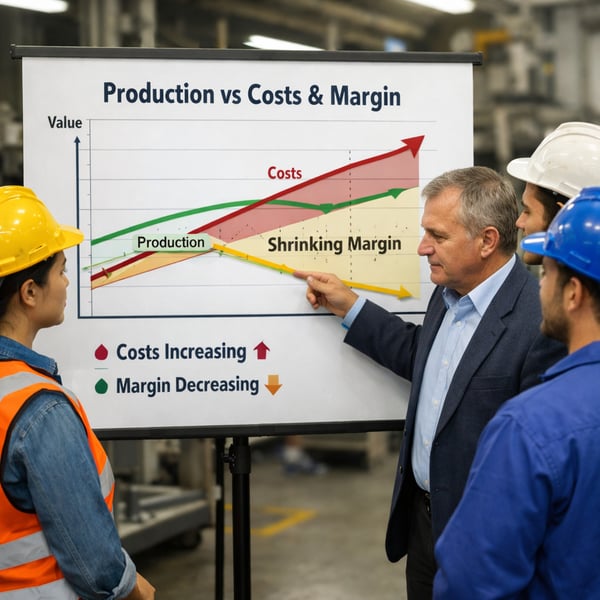
The May ISM Manufacturing PMI just hit 54% — the highest since May 2022. Manufacturing is booming. But the ISM Prices Index at 82.1 tells a different story: input costs are rising faster than most manufacturers can absorb.
Tariffs have pushed the average effective rate on US imports from 2.2% to 17%. The Iran conflict is keeping oil above $90. And 86% of manufacturers plan to pass costs to customers. That works — until your competitor finds a way to hold their prices and you lose share. Price increases are temporary; operational cost reduction is permanent.
The manufacturers protecting margins right now aren't raising prices. They're finding hidden capacity and eliminating waste from the inside.
5 Ways to Protect Your Margins from the Factory Floor
1. Improve OEE — Find the Capacity You're Already Paying For
If your factory runs at 60% OEE — the mid-market median — 40% of your labor, energy, and overhead is producing nothing. Improving to 75% adds 25% capacity from existing equipment.
We took a window manufacturer from 40% OEE to 83% — adding $2M in annual revenue and $50,000/month in cash flow. No new equipment. No added shifts. Just better systems on the floor.
A similar situation occurred for a sports equipment manufacturer relocating from China to Mexico. We redesigned their manufacturing layout and equipment usage to reduce labor requirements from 1,200 employees in China to 350 employees in Mexico. Automation played a role, but the greatest gains came from increasing OEE with existing equipment.
2. Reduce Changeover Time
In high-mix factories, changeover is often the single largest capacity loss. We routinely see 45-90 minute changeovers that could be done in 15-20. SMED methodology — film a changeover, separate internal from external tasks, move external tasks outside the window — typically cuts time by 50-70%.
On a line running $200/hour in production value, cutting 30 minutes per changeover across 3 changeovers per day saves $90,000/year. From one line.
3. Implement Preventive Maintenance
Emergency repairs cost 3-9x more than planned maintenance. Every $1 invested in PM returns more than $5. Yet nearly half of all manufacturing maintenance is still reactive — fixing things after they break.
Start with your top 5 critical machines. Document checklists. Train operators on basic autonomous maintenance. The cost of holding a $200 spare bearing is trivial compared to a $180,000 line-down event.
Preventive maintenance is often one of the hardest changes to implement. Manufacturers, especially in China, want to run machines until they break. The cost of a machine down for maintenance is greater to them than the cost of bad quality or the cost of a broken machine. Years ago, we worked with an eye glasses manufacturer in China. The company was a major supplier to European and American brands. They often had a lot of rework. We found that they did not regularly sharpen their cutting knives for plastic glasses. When asked about it, the supervisor said that there was no need to sharpen the knives since the plastic was much softer than steel.
Implementing a routine sharpening schedule dropped rework significantly and improved overall quality. A simple fix that had been ignored for years.
4. Eliminate Scrap and Rework
Every defective part consumed time, material, and energy without producing revenue. Rework doubles your cost per unit while tying up capacity. See the example above. Dozens of workers were required to rework the glasses frames that were not cut correctly.
In a recent engagement, we cut scrap rates by 50%, saving approximately RMB 3 million annually. The tools are established — process control plans, mistake-proofing, and operator training. The question is whether they're implemented consistently as a daily operating system.
5. Optimize Your Supply Chain
With tariffs at 17%, where you source matters more than ever. But most manufacturers only manage Tier 1 pricing. One-third of Mexico's export value is Chinese content — if your components still come from China, you may have added cost without reducing exposure.
We achieved a 10% procurement cost reduction for a client through improved supplier management — not squeezing on price, but consolidating orders, improving incoming quality, and eliminating suppliers that created more cost than they saved.
Want to find the hidden cost in your operation?
MTG starts every engagement by measuring what's actually happening on the floor. The gap between perception and reality is where the savings are. Book a free consultation to discuss your situation.
The Math: Operational Improvement vs. Price Increases
For a manufacturer with $20M in revenue and 8% operating margin:
| Approach | Margin Impact |
|---|---|
| Raise prices 3% | +$600K — but risks customer loss |
| Improve OEE 10pts + cut scrap 50% + implement PM | +$850K-$1.9M — permanent, zero customer risk |
Operational improvement delivers equivalent or better results than price increases — without risking a single customer relationship. For a deeper dive on where to start, read our complete OEE guide.
How MTG Can Help
Manufacturing Transformation Group has been reducing costs from the factory floor since 2012 — across China, North America, Mexico, and Vietnam. Recent results: OEE from 40% to 83%. Scrap cut 50%. Inventory turnover from 38.5 to 14 days. Capacity increased 30%+. All without capital investment.
If your margins are under pressure, there is almost certainly recoverable cost inside your operation. We find it and help you capture it.
Margins under pressure?
We've helped manufacturers across four continents find $500K-$2M+ in operational savings — without raising prices. Let's talk about what's possible in your plant.