

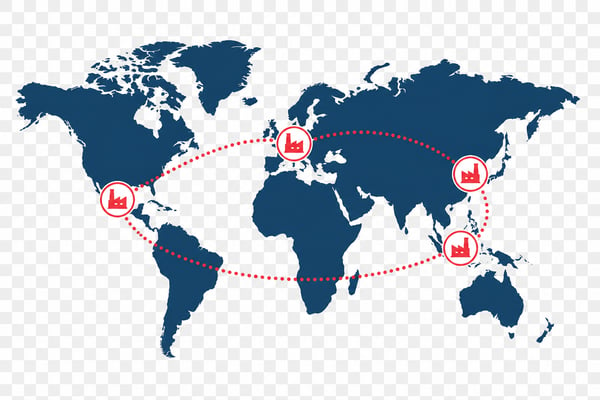
MTG has managed factory operations across China, Vietnam, Mexico, Europe, and the United States. Every country has strengths that make it attractive for manufacturing and blind spots that cost companies time, money, and quality. The mistakes are predictable — they just look different depending on where you are. Here is what we have learned about what each region gets wrong and what it takes to get it right.
Written by David Collins III, CEO of Manufacturing Transformation Group.
China: Speed Over Process
China's manufacturing infrastructure is extraordinary. The supplier ecosystems, the speed of tooling, the sheer scale of production capacity — there is nothing like it anywhere else in the world. When a client needs to go from concept to mass production in three months, China is usually the answer. In the last year, we had a client say how they had new tooling ready in China within a few weeks and an American supplier saying that it would take a few months. The difference is night and day.
But China's biggest strength is also its biggest blind spot: the belief that speed and volume solve everything. I want to add a strong caveat here. This is not all factories in China. However, these beliefs are still well entrenched. Chinese companies still try to throw people at a problem to solve it quickly even though that is becoming less viable everywhere. The belief that volume cures all issues is even more durable.
We have managed operations in Chinese factories where the response to a quality problem was to run the line faster and sort out the bad parts at the end. The thinking is straightforward — if you produce enough volume, the yield of good parts will meet the customer's order quantity. The scrap gets absorbed as a cost of doing business. Nobody stops to ask why the defects are happening in the first place. The defects matter less than making production.
The other pattern we see constantly is the gap between the quality system on paper and what actually happens on the floor. The factory has ISO certification. The process control plans exist. The documentation looks professional. But walk the production line at 2 PM or 2 AM and you will find operators skipping inspections, using unauthorized shortcuts, and running settings that are different from what the setup sheet specifies. The tendency exists everywhere but it is strong in China.
Middle management is often the bottleneck. In our experience, Chinese factory middle managers resist change more than any other group we work with. They are protecting their position, their relationships, and their way of doing things. Getting real improvement in a Chinese factory requires either winning over the middle managers or working around them — and that takes local presence, not emails from headquarters. We had an expression in the military: the further you are from the flagpole (headquarters) the less they will actually check on you. Middle managers are on the front line. As long as there are no major issues, management tends not to bother them.
Factory owners add another layer. Many do not want their buyers to see operational flaws because they fear it will lead to price concessions. Plus there is a point of pride concerning their factory. No one wants to admit they aren't doing the best they can. When we assess a Chinese factory, the first challenge is often getting past the carefully staged tour and seeing what the operation actually looks like when nobody is watching.
Mexico: The Nearshoring Illusion
Mexico has become the default answer for companies looking to reduce dependence on China. It is closer, it is in a similar time zone, and USMCA provides tariff-free access to the US market (at least in theory. We recommend that you check on the tariff status often). On paper, it checks every box.
The reality on the ground is more complicated. Hint: it always is more complicated.
The biggest challenge in Mexico is workforce turnover. Along the northern border, where most export-oriented manufacturing is concentrated, annual turnover rates of 40-80% are common. In some maquiladoras, it is over 100%. That means the average operator has been on the job for less than a year. Every month, you are training new people — and every month, some of the people you just trained leave for the factory down the street that is offering 50 pesos more per day. A previous client tried everything to keep staff including better food, good pay, and better facilities. People still left for slightly higher wages.
This makes standard work and training systems absolutely critical in Mexico. But many companies moving production there do not invest in these systems because they assume the workforce challenge will be similar to what they are used to. It is not. A factory in Juárez operates in a fundamentally different labor environment than a factory in Ohio or Shenzhen.
The other mistake we see is companies treating Mexico as a plug-and-play replacement for China. There is no replacement for China. It's its own culture and ecosystem and so is Mexico. Mexico's supplier ecosystem for many product categories is still developing. If your product requires specialized components that you used to source from a cluster of suppliers within 50 kilometers of your Chinese factory, you may find that those components need to be imported into Mexico, which adds cost, lead time, and complexity that was not in the original business case. One issue we found in particular was steel. No country can compete with the sheer volume of Chinese steel. The factories could compete on every product our client wanted but only if they used Chinese steel.
Vietnam: Growing Pains
Vietnam is the rising star of global manufacturing. Low labor costs, a young workforce, government incentives for foreign investment, and a geographic position that serves both Asian and Western markets. Companies that moved production out of China in 2025 often landed in Vietnam.
The challenge is that Vietnam's manufacturing sector is scaling faster than its management talent.
We work with factories in Vietnam where the production equipment is world-class — brand new machines, modern facilities, clean layouts. But the management systems are five to ten years behind the equipment. There are not enough experienced production managers, quality engineers, and maintenance supervisors to staff the factories that are being built. This can lead to disconnects between workers and managers especially when the managers are from foreign countries. We had a Taiwanese production manager tell us that they need help because her production designs were "perfect" (direct quote) but the local workers would not follow the plan.
The result is factories that look impressive during a walkthrough but struggle with consistency. First article samples are perfect. The first production run is acceptable. By the third or fourth run, quality starts to drift because the institutional knowledge of how to maintain process control has not been built yet. This is not true across the board, of course, but it is something anyone reshoring to Vietnam has to look at.
Vietnam also has a cultural tendency toward avoiding direct confrontation with customers or management. When there is a problem on the line, the instinct is to fix it quietly rather than escalate it. This means issues that should trigger a corrective action process instead get patched over �� and they recur. It is an issue everywhere (people hate to admit there is an issue) but it is an acute problem in Vietnam.
The companies that succeed in Vietnam are the ones that invest heavily in training local management and building systems before they ramp volume. The ones that fail are the ones that bring in equipment, hire operators, and expect production to run itself. We often act as our client's representative in Vietnam to develop these systems and the manufacturing infrastructure.
Europe: Process Rigidity
European factories — particularly in Germany, Switzerland, and Scandinavia — are often held up as the gold standard of manufacturing. And in many ways they are. The process discipline, the engineering depth, the quality culture — these are real and hard-earned. But that same discipline can become a liability when the market demands change.
We have worked with European manufacturers who take six months to approve a process change that a Chinese factory would implement in two weeks. The change control process is thorough, documented, and validated at every step. It is also painfully slow. When your customer needs a modified part in 30 days and your change control process takes 90, you have a problem.
The other pattern we see in Europe is resistance to operational input from outside the organization. European manufacturers are proud of their engineering heritage. But that pride can make it difficult to accept that an outside consultant might see something they missed. The "not invented here" syndrome is real, and it means improvement opportunities get dismissed because they did not originate internally. We have found the situation better in Eastern Europe especially when companies invest in developing local leadership. Our team worked with a Polish factory and the supervisors were enthusiastic to learn and develop as manufacturing leaders.
Cost is the other challenge. European manufacturing is expensive, and that cost structure only works if you are competing on quality, precision, and technical capability — not on price. The factories that thrive are the ones that have a clear understanding of what they compete on and do not try to win business that should go to a lower-cost region. It is a great place for high quality precision parts. We have clients that import specific components from Europe because no one does it better.
United States: The Reshoring Reality Check
The US is in the middle of a manufacturing renaissance — at least in the headlines. Billions in announced investments and government incentives. Political support from both parties. The narrative says manufacturing is coming home but not nearly to the degree that people believe.
The reality is harder. 500,000 manufacturing jobs are unfilled. The skilled workforce that offshoring hollowed out over 20 years cannot be rebuilt in 20 months. Companies that reshore production often discover that the tribal knowledge of how to run a factory — the maintenance technicians, the toolmakers, the experienced supervisors — simply does not exist in the local labor market. We have helped clients rebuild this knowhow and institutional knowledge but it is a long process.
The other blind spot is cost expectations. Companies that have been manufacturing in China for a decade have internalized Chinese cost structures. When they reshore, they are shocked by the fully loaded cost of domestic production — not just wages, but benefits, workers' comp, environmental compliance, energy costs, and the overhead of running a facility in a high-regulation environment. Sometimes the difference can be due to opaque Chinese pricing. It is not uncommon for factories to run on very thin margins so they can make it up in volume (remember earlier?). Additional American manufacturing is running into the fact that they still need to import large amount of components. The American manufacturing ecosystem just does not produce certain components. Tariffs actually work against, rather than for, expanding American manufacturing.
Reshoring works when it is done for the right reasons: defense requirements, heavy goods where shipping dominates landed cost, or products with very short lead time needs. It does not work when it is done purely as a tariff play — because tariff rates change, but the cost of building and staffing a factory does not. I won't be surprised if tariffs fall significantly after the next election in 2028.
The One Mistake Every Country Makes
Across every country, every industry, and every size of factory, there is one mistake that shows up everywhere: assuming that what worked somewhere else will work here.
Companies move production from China to Mexico and try to run the Mexican factory like a Chinese one. It does not work even for Chinese companies. Companies acquire a European factory and try to impose American management practices. It backfires. Companies set up in Vietnam and expect Chinese-level supplier ecosystems. They do not exist yet (and may never).
Every manufacturing environment is shaped by its local culture, labor market, supplier ecosystem, and regulatory environment. The companies that succeed globally are the ones that adapt their management approach to the local context — keeping their standards and expectations consistent while adjusting how they achieve them.
That is what we do at MTG. We do not bring a one-size-fits-all playbook. We bring experience across multiple countries and the judgment to know what will work where — and what will not.
Manufacturing across borders?
MTG has teams on the ground in China, Vietnam, Mexico, and across North America and Europe. Whether you are setting up a new factory, managing an existing supplier, or evaluating a production move, we bring local knowledge and global perspective. Get in touch to discuss your situation.