

Over 500,000 manufacturing jobs are unfilled in the US. The problem is not wages — it is a broken training pipeline, an aging workforce, and decades of underinvestment in developing the next generation of skilled operators, technicians, and supervisors.
Every article I read about American manufacturing and the state of the US economy, the author mentions the labor shortage. 500,000 unfilled jobs. 2.1 million projected by 2030. A trillion-dollar GDP impact.
It then moves to a conversation about the role of automation and, more recently, AI. While both of those deserve consideration (I am less certain about AI at this time) they are not the primary problem.
I have spent the last decade inside factories across China, Vietnam, Mexico, and the United States. The labor shortage is real. But after working with hundreds of manufacturers, I am convinced the problem is not that we cannot find workers.
The problem is that we refuse to train them. Many are not given much more than a basic training let alone cross training across multiple jobs. Too many companies want to hire someone with all the skills they need rather than developing the workforce.
When I was a young man, I served in the US Army. The Army (and other branches of the services) did not recruit people for their skills; it recruited people it could train and mold into who they needed them to be. There was a clear system to train people for the basic skills they needed to a soldier and further training for advanced skills. We went into training as an unskilled civilian and left as a trained soldier. Manufacturing jobs should have this mindset (without the push-ups).
The Paradox on Every Factory Floor
A plant manager tells MTG they cannot find experienced operators. They need people with 5-10 years of experience running specific equipment. They post the job. Nobody qualified applies. They blame the labor market.

Meanwhile, there are people in the building -- assemblers, material handlers, junior operators -- who have been there for two or three years and have never been taught how to run that equipment. Nobody invested in moving them up.
The factory is sitting on its own talent pipeline and ignoring it. They prefer to find someone with the skills they need rather than developing those skills themselves. Don't be afraid to train the workforce you need rather than finding it off the rack.
"We Don't Have Time to Train"
It is a common refrain and rarely true. Every factory is busy. It is likely that you don't have time to set up a class room and go through slides. But you should have time to provide hands-on training; first through observation and second through actually working on the machine or process.
One of our clients in China had this exact problem. Forty percent of their quality defects traced back to operator error. Not because the operators were careless -- because nobody had written a work instruction in the last eight years and no one trained new hires to the standards. New hires learned by watching the person next to them, who learned by watching the person before them. By the third generation, the process had drifted so far from the original intent that nobody could explain why they did it that way. That's just how it was done.
We spent three weeks writing clear, visual work instructions for their twelve highest-defect processes. Within two months, their first pass yield improved by six points. Not from new equipment. Not from AI. From a laminated sheet of paper on the workstation. While the example is from China, similar situations appear just as frequently in US factories. New people are not given a systematic training to actual posted standards.
The Training That Actually Works
Most factory training programs fail because they are built by HR, not by the people who do the work. They check a compliance box and then nothing changes on the floor.
Here is what we have seen work across dozens of factories:
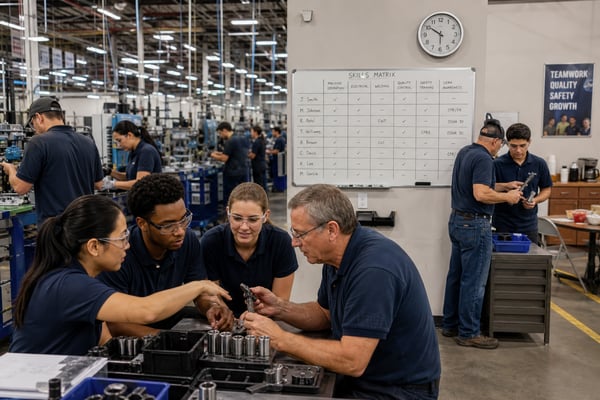
Train at the workstation, not in a classroom. A four-hour classroom session on quality principles will be forgotten by Tuesday. Fifteen minutes of hands-on coaching at the machine while the operator runs real parts sticks permanently. Make training a structured part of every employee's job. When I worked on a factory line in college at W.L. Gore & Associates, every associate was expected to cross-train across multiple stations. It was built into the culture from the beginning. Even the leadership new how to operate all the equipment.
Use the operators to build the training. The best person to write a work instruction is the operator who runs the process every day -- not an engineer who visits the floor once a week. We have seen operators take ownership of quality when they are the ones who defined what "good" looks like.
Make skills progression visible. In one Mexican factory, we implemented a simple skills matrix on a whiteboard near each production line. Every operator could see which machines they were certified on and which ones they were training toward. Nobody told them to cross-train. They started asking for it.
Pair new hires with veterans for 90 days, not 2. Most factories give new operators a week of shadowing and then throw them into production alone. The factories with the lowest turnover and highest quality extend that pairing to 90 days -- with structured checkpoints, not just "follow Carlos around." We do this ourselves. MTG primarily hires people with at least a decade of manufacturing experience.
What China Taught Me About Training
In Chinese factories, the training challenge is different but the lesson is the same.
Turnover in Chinese manufacturing runs 30-50% annually in some regions and industries. Usually, turnover happens around Chinese New Year as employees do not return from their family homes or go somewhere else. For that reason, Chinese factories rely heavily on their existing employees (who may not be well trained themselves) to rapidly train new employees. The first month or so after Chinese New Year operations suffers as the companies quickly train new staff. The workers often work hard and learn fast so production stabilizes by April. Stabilize does not mean improve operation. Since proper training has not often provided, bad habits continue from generation to generation. Chinese factories often throw more people at a problem rather than deal with underlying issues. As labor markets tighten, we do see less of that but the general method remains.
A strong training system can alleviate the turnover problem. Instructions, specified training methods, and redundancy would prevent the chaos that occurs each year. Chinese companies often worry that if they train people the workers would leave for another better paying job so training is often neglected.
American and European manufacturers have their own problems. There is a great reliance on "tribal knowledge". One guy knows how to run each piece of equipment and the process would fall apart without him.
The Automation Trap
"We will just automate those jobs."
I hear this constantly. And for some processes, automation is the right answer. But automation does not eliminate the need for skilled workers. It changes what skills they need.
An automated production line still requires people who can troubleshoot when something goes wrong. Who can interpret data from sensors and make adjustments. Who can manage changeovers and maintain equipment. These roles require more training, not less.
One of our clients bought an expensive production line. It looked great and was never used. The production line sat to the side as a nice coat rack. The problem was it was not a good fit for the production process. Our team instead focused on training. We took each supervisor and cross trained them with all other functions. The supervisors, in turn, trained their people on the use of different processes and activities. After our one year engagement, the factory had a strong cadre of leaders that were apt at training and finding new solutions.
What I Would Change
If I could convince every manufacturer of one thing, it would be this: training is not a cost. It is the highest-return investment you can make on the factory floor. Much like education spending is one of the highest returns a country can have for its spending.
A $50,000 training program that improves first pass yield by three points will save ten times that in reduced scrap, rework, and customer complaints. Every year. Compounding. Few other programs have that type of value.
But it requires a mindset shift:
Stop hiring for experience. Start hiring for aptitude and training for skill. The 25-year-old who has never run a CNC machine but shows mechanical aptitude and reliability will outperform the experienced operator with bad habits within six months -- if you invest in training them.
Make training the production manager's job, not HR's. The person accountable for output should be accountable for the skills that produce that output.
Budget for training like you budget for maintenance. No factory manager would skip preventive maintenance on a million-dollar machine. But they skip training for the people who run it. Both lead to breakdowns.
Document everything. If your processes are not written down, you do not have a training program. You have a game of telephone that degrades with every new hire.
The Real Labor Shortage
The labor shortage is real. But it is not 500,000 people who do not exist. It is 500,000 people who have not been trained yet.
They are already in your building. They are in your community college down the road. They are the career changers who would thrive in manufacturing if someone showed them the path.
The factories that figure this out will not just survive the labor shortage. They will turn it into their biggest competitive advantage.
Manufacturing Transformation Group builds training systems, work instructions, and skills development programs inside factories across China, Vietnam, Mexico, and the United States. If your team's skills are the bottleneck, [let's talk](https://www.mtg-transform.com/meetings/david-c-collins3).