

Key Takeaways
- ISM Manufacturing PMI hit 52.7 in March — fastest expansion since 2022
- Mid-market manufacturers are driving reshoring with $50M to $300M investments
- Three risks threaten sustainability: workforce gaps, supply chain fragility, and policy uncertainty
- Focus on the fundamentals: standardize operations and map supply chains before scaling
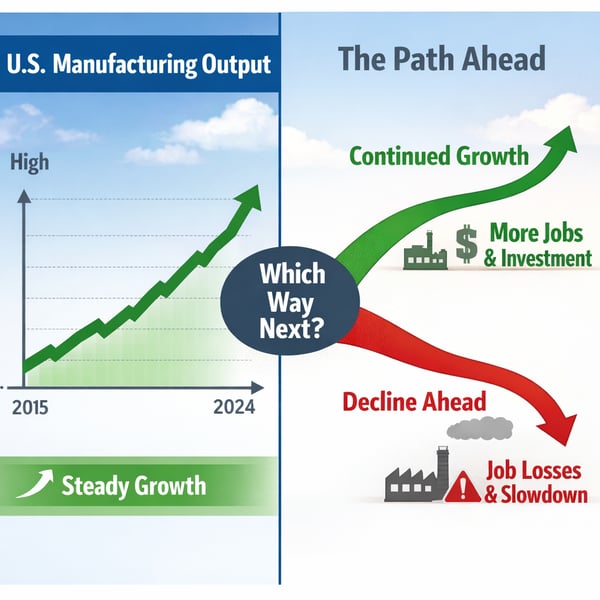
The ISM Manufacturing Index just registered 52.7 in March — the fastest expansion since August 2022. That's the third straight month of expansion. The Production Index has been expanding for five consecutive months. The Philadelphia Fed Manufacturing Index surged past forecasts in April. And Q1 2026 delivered the first positive manufacturing job growth in three years.
The headlines are calling it a comeback. But is this sustainable growth — or a policy-driven sugar high that could reverse as fast as it started? Our experience over the past six months suggest that both could be true. We recently started working with a manufacturer that is moving manufacturing out of the US to China to support a large client. Other clients are moving to Mexico, Vietnam, and the US.
The answer, as always in manufacturing, depends on what's happening on the floor. Concrete investment rather than grandiose promises will decide what happens next.
What's Driving the Expansion
The numbers aren't abstract. Real capital is flowing into US manufacturing at a scale we haven't seen in decades.
The mega-deals grab headlines — Apple, Nvidia, J&J — but the real story is in the mid-market. Whirlpool put $300 million into its Clyde and Marion, Ohio operations, projecting 450-600 new jobs. Deere & Co. is opening a $70 million excavator factory in Kernersville, North Carolina. In Mexico, Abbott Laboratories opened a $200 million electrophysiology plant in Querétaro, Medline is investing $250 million in Nuevo Laredo, and Becton Dickinson is building an $80 million third plant in Ciudad Juárez. U.S. Steel is restarting the Gary Tin Mill — 225 jobs.
On the PE side, the pattern is the same: Littlejohn & Co. acquired 80/20, a maker of modular framing solutions, to expand into automation and robotics. FirmaPak acquired Easy Plastics, a Canadian blow molder, to add manufacturing capacity in personal care and pharma packaging. PE firms are placing a stronger emphasis on reducing COGS — 62% of PE manufacturing investors prioritize supply chain rationalization and production process improvement as their primary value creation lever.
These relatively smaller investments are a better sign for the general economy and continued growth. As a rule, I am hesitant of promises from players like Apple. Pledging large investments for headlines is not the same as investing. Remember Wisconsin and Foxconn.
Three forces are converging:
Tariff-driven reshoring. With universal tariffs at 10% and tariffs on Chinese goods above 30%, the financial calculations have shifted. Manufacturing domestically or in USMCA-covered Mexico is increasingly competitive against offshore alternatives — especially when you factor in freight volatility and lead time risk.
New orders are real. The ISM New Orders Index expanded for three consecutive months. This isn't just inventory restocking or front-loading ahead of tariff changes. Companies are placing new orders because demand is there.
Mexico nearshoring continues to accelerate. FDI into Mexico's manufacturing sector was up 10% year-over-year in 2025, with 36% flowing directly into manufacturing. The USMCA framework gives North American production a structural advantage — at least for now.
Three Risks That Could Derail It
Behind the strong headline numbers, there are real fault lines that could slow or reverse this momentum.
Risk 1: The Workforce Gap
Q1 delivered the first positive manufacturing job growth in three years. But the talent pipeline hasn't caught up to the investment pipeline. The ISM Employment Index actually contracted slightly in March (48.7), even as production expanded — meaning factories are producing more with fewer people.
It is not a sustainable system for continued growth. AI cannot fill most of these manufacturing jobs.
The roles that are hardest to fill — CNC operators with multi-axis experience, maintenance techs who can troubleshoot both Programmable Logic Controllers (PLCs) and cobots, quality engineers with IATF background — take months to recruit and train. Starting July 1, Pell Grant eligibility expands to short-term manufacturing training programs, which is a step in the right direction. But institutional training alone won't close the gap.
What works on the ground: structured on-the-job training with documented skill matrices, cross-training programs that eliminate single points of failure, and partnerships with local community colleges to co-design curricula around your actual equipment. We've seen these approaches work firsthand in factory turnarounds across four continents. Companies should not be afraid to take new workers and mold them into the role they need them for. It works well in the military and major companies like Michelin have been successful with this approach.
Risk 2: Supply Chain Fragility
Supplier delivery times lengthened in March to levels not seen since October 2022. The ISM Prices Index jumped to 78.3 — the highest since June 2022 — driven by tariff-related cost pass-throughs and raw material inflation.
The uncomfortable truth: many companies that claim to have "diversified" their supply chains have really just added a step. Assembly moved to Vietnam or Mexico, but 60-70% of components still originate in China. When we work inside supplier factories, the concentration risk at Tiers 2-4 is almost always worse than leadership assumes.
The War with Iran and Strait of Hormuz disruptions continue to keep freight routes volatile. Oil briefly topped $100 per barrel earlier this year. Air freight rates remain and are likely to remain elevated through the short term. The manufacturers who weather this aren't the ones who predicted the right disruption — they're the ones who built operations flexible enough to handle the disruption.
Risk 3: Policy Uncertainty
This is the risk nobody wants to talk about while the numbers are good.
Companies are committing hundreds of billions of dollars based on the current tariff and incentive structure. But that structure is anything but permanent. The current US administration has a history of volatile policy changes. Here are a few possible ways that the situation could change.
- The USMCA review starts July 1 — rules of origin could tighten, especially for automotive. The 75% regional value content threshold may increase.
- Universal tariffs sit at 10% until July 24, with threats of escalation to 15%.
- The $7,500 EV tax credit expired in September 2025. US EV sales are projected to drop 25% in H1 2026. Automakers have absorbed $65 billion in writedowns. Battery plants are being repurposed for data center markets.
- The ISM Prices Index at 78.3 signals inflation pressure. If costs rise too fast, the Fed's response could slow the broader economy — and manufacturing with it. Inflation is already a challenge.
The question isn't whether the current expansion is real. It is. The question is whether the operational foundation underneath it can sustain it when — not if — conditions change.
Concerned about your supply chain exposure?
Manufacturing Transformation Group helps manufacturers map supply chains, build operational resilience, and prepare for policy shifts — across China, North America, Mexico, and Vietnam. Book a free consultation to discuss your situation.
What Manufacturers Should Be Doing Right Now
Growth without systems creates chaos. We've seen it repeatedly: companies scale capacity during an upswing without standardizing operations, then spend the downturn firefighting quality problems, cost overruns, and delivery failures that were baked in during the expansion. They throw workers and equipment at the problem but in haphazard manner and rarely in a way that is sustainable.
Here's what the smartest manufacturers are doing right now:
Invest in workforce development before you're desperate. Build skill matrices for every operator. Cross-train to eliminate single points of failure. Partner with local community colleges. The time to build your talent pipeline is when you have breathing room — not when you're turning down orders because you can't staff the line. Our team helped a manufacturer in Poland do cross train its staff and eliminate points of failure. It made them more resilient and more profitable.
Map your full supply chain — now. Not just Tier 1. Map Tiers 2 through 4, identify concentration risk, and build qualified alternative sources before you need them. Every month you delay this is another month of exposure.
Standardize your operations before scaling. Standard work instructions, visual management, process control plans — these aren't luxuries for lean purists. They're the foundation that allows you to scale without quality and efficiency falling apart. If 5 operators do the same job 5 different ways, adding a sixth won't help.
If you're PE-owned: this is the window. Manufacturing multiples are supported by the expansion narrative right now. The time to invest in portfolio company operations — turnarounds, lean implementation, capacity optimization — is while the cycle supports it. Waiting until the cycle turns means you'll be cutting costs instead of building value.
How MTG Can Help
Manufacturing Transformation Group has been helping manufacturers capitalize on growth — and survive downturns — by fixing the operations underneath the numbers. Factory turnarounds, new factory setup, lean implementation, supply chain optimization, and workforce development across China, North America, Mexico, and Vietnam since 2012.
Whether you're scaling up, reshoring, nearshoring, or trying to get more out of an underperforming plant — we've done it before, on the factory floor, in your industry.
Ready to build operations that can sustain this growth?
We've helped manufacturers across four continents turn expansion into lasting competitive advantage. Let's talk about what's possible in your operation.