

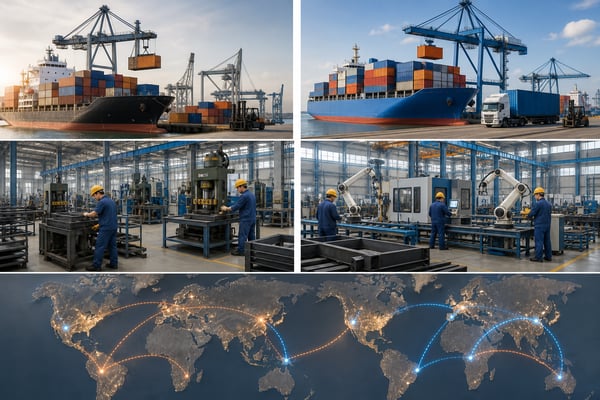
MTG has helped 12 companies move production out of China. The process is harder, slower, and more expensive than anyone expects. This article covers what actually happens during a production move — the hidden costs, the timelines, and the lessons nobody talks about.
Everyone is talking about China+1. Most of the advice comes from people who have never set foot in a factory.
Consultancies are publishing frameworks. Governments are offering incentives. Your board is asking questions. After all that, is it worthwhile to make the move or is it just something to talk about?
Over the past three years, our team has helped manufacturers move production from China to Vietnam, Mexico, and other markets. We have worked inside the factories — not from a conference room, but on the floor, standing next to the equipment, talking to the operators.
Here is what we have learned.
1. The Tariff Math Looks Simple. The Real Math Is Not.
A client came to us with what seemed like a straightforward calculation. Their product carried a 52% effective tariff from China — Section 301, Section 232 on steel content, plus the Section 122 surcharge. Moving to Vietnam would drop that to roughly 12%.
On paper, that is a $85-per-unit savings on a $340 product. At 10,000 units a year, that is $850,000 in annual savings. The case for moving seemed obvious.
Then we started digging.
The Vietnamese contract manufacturer quoted similar unit costs, but their defect rate during trial production was 8% versus 2% in China. Rework and scrap ate into the savings. The steel they sourced locally met specifications on paper but behaved differently during welding — different alloy composition, different heat treatment. The factory had the right equipment but the operators had never built this type of product before. There would be a steeper learning curve than expected.
Within three months, the real savings were closer to $400,000 — still significant, but half of what the spreadsheet promised.
The lesson: Tariff savings are real, but they are the ceiling, not the floor. Production quality, supplier maturity, and workforce readiness determine where you actually land.
2. Your Chinese Supplier Is Better Than You Think
After a decade of working in Chinese factories, we have seen something that surprises most Western executives: the quality and efficiency of mature Chinese manufacturers is genuinely difficult to replicate quickly.
A mid-size Chinese factory producing a complex assembled product typically has:
- Operators with 5–10 years of experience on that specific product
- Supply chains optimized over years of iteration
- Quality systems that evolved from fixing real problems, not from a template
- Informal institutional knowledge that exists nowhere in writing
When you move to a new country, you start from zero on all of these. The factory may have good equipment and motivated workers, but they have never made your product. Every process that runs automatically in China requires conscious effort in the new location.
One of our clients expected their Vietnamese facility to reach Chinese quality levels within six months. It took fourteen months — and that was with our team on the ground full-time managing the transition.
An important note: the example is for a mature Chinese supplier. For every good supplier we see, there are at least one that is not living up to its potential. We recently worked with another company that has been manufacturing in China for decades. The factory was a mess. Too many KPIs, substandard OEE, excessive inventory, and on-time delivery (OTD) at 30%. The factory has enough room to improve that it could overcome any of the tariff price increases and achieve the pre-tariff or better results.
The lesson: Budget 12–18 months to reach comparable performance. If someone tells you three months, they have not done this before.
The Second Lesson: Assess your Chinese factory before you make any decisions.
3. The Factory Is Ready. The Supply Chain Is Not.
This catches people every time.
The new factory passes the audit. Equipment is installed. Workers are trained. Trial production looks acceptable. You green-light full production.
Then a critical component runs out and the local supplier cannot deliver for six weeks. In China, you would have had three alternative suppliers within a two-hour drive. In Vietnam or Mexico, you might have one — and they are still qualifying your specs. That's if you go local. Oftentimes, the components are not available locally and still need to be sourced from China. That is especially true when it comes to electronics and steel. One of our clients wanted to move to Mexico and found that buying North American steel eliminated any gains made by the move.
The lesson: The factory is the easy part. The supply chain around it takes twice as long to build and is three times more likely to cause delays.
4. The China+1 Decision Is Not Really About China
The companies that succeed with diversification are not running away from China. They are running toward resilience.
The best outcomes we have seen follow this pattern:
- Keep China for complex, high-volume, mature products where the supply chain is optimized and quality is consistent
- Move to Vietnam or Mexico for new product lines where you are building from scratch anyway
- Use the transition to improve your processes — the documentation, training systems, and quality frameworks you create for the new factory will improve your Chinese operations too
The worst outcomes happen when companies treat it as a pure cost exercise. Move everything, move it fast, find the cheapest option. Those projects end up costing more than staying in China.
5. You Need Someone on the Ground
That sounds like it a pitch for our service. In part it is. No sense in denying it. We help companies with exactly this challenge. However, our experience shows that having a trusted 3rd party drive the effort can be more time and cost effective than doing it yourself.
Companies that manage the transition remotely struggle. Video calls with the factory are not enough. You cannot troubleshoot a welding defect over Zoom. You cannot assess whether an operator truly understands the process from a Teams call.
The companies that succeed have someone physically present in the new factory — not for a week-long audit, but for months. Someone who speaks the language, understands the manufacturing culture, and can intervene in real time when problems emerge. It is very common for North American and European companies to make long trips to China to drive the change they want. It is time consuming, expensive, and quite often not effective. Suppliers and manufacturers will tell you what you want to hear. You may help them come up with a solution but, without the reinforcement over time, they will go back to their old way of doing things. That is not a China thing; it is a human thing.
The same logic applies to moving manufacturing to a new location. One of our current clients is moving from China to Vietnam. MTG found the suppliers, qualified them, and went with our client on-site to assess them. Now our team is leading the effort on the ground to transfer production. Our local staff in Vietnam is much less expensive than sending people back and forth from the United States to Vietnam and far less disruptive.
Whether that is your own team or an outside partner, the on-the-ground presence is the single biggest predictor of success we have seen across all our China+1 projects.
What We Would Tell You Over Coffee (or a beer if that's your preference)
If you are sitting in a boardroom looking at a China+1 spreadsheet, here is our honest advice:
- Do it. Or at least study it in depth before making a move. Diversification is the right long-term strategy. The tariff and geopolitical environment is not going back to 2017.
- Do not rush it. A poorly executed move costs more than staying put. Plan for 18 months from decision to full production.
- Keep your Chinese operations running while you build the new capability. Do not create a production gap.
- Invest in the transition like you would invest in a new product launch — with dedicated resources, milestones, and someone accountable for quality.
- Get your documentation in order first. If your BOMs, work instructions, and quality specs are not written down in China, you have nothing to transfer to the new location.
The China+1 opportunity is real. But it rewards the prepared, not the panicked.
Manufacturing Transformation Group has teams operating across China, Vietnam, Mexico, and Thailand. We help manufacturers plan and execute production transitions with hands-on, factory-floor support. If you are evaluating a China+1 strategy, let us talk.