

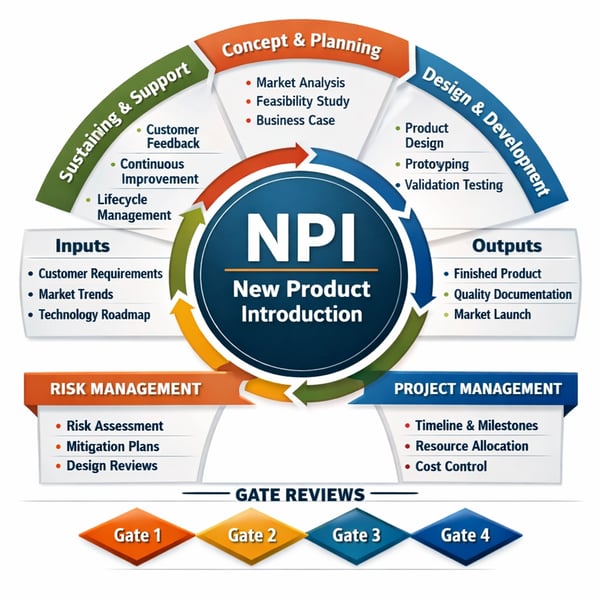
Companies often struggle with NPI as it requires coordination across the entirety of the organization. Design engineers often neglect the manufacturability of the product. When this occurs, products are often excellent but cannot effectively be produced at scale. This is why NPI is a standardized process to ensure that end result meets the company’s needs.
Early Engagement and Project Qualification
The NPI process typically begins when a potential project is identified—either from existing customers, market research, or strategic initiatives. The first step is assessing whether the opportunity aligns with business objectives. This is done through a formal review team responsible for determining whether the organization should pursue the project, request additional information, or decline the opportunity.
If the potential customer or application is new, a background or capability check is performed to ensure the business can support the project requirements. This avoids the risk of committing resources to projects that are financially or operationally unsuitable. It is not uncommon, especially in China and India, for companies say yes first then figure out how to make the product. While this can work, it often does not, which can lead to poor quality, price overruns, and delays. Make sure any supplier you use has a clear NPI process and that it is followed.
Quote Review and Feasibility Assessment
Once the project is accepted for further exploration, it enters a detailed feasibility review conducted by a cross functional quote review team. This group evaluates:
-
Technical feasibility – whether the product can be designed and manufactured reliably.
-
Costing and pricing – ensuring the solution is financially viable.
-
Manufacturing requirements – identifying new equipment, tooling, or processes.
-
Regulatory, safety, or environmental considerations – ensuring compliance with all standards.
During this stage, design rules and guidelines are referenced, and potential advanced quality requirements (such as FMEA, capability studies, or APQP elements) are identified.
If the team concludes that the product can be manufactured at acceptable cost and risk levels, a formal quotation is generated. If not, the project may be modified, deferred for development work, or rejected. The manufacturing, purchasing, and planning teams need to be included at this stage as they will provide critical insights that will guide the decision.
Detailed Design and Customer Validation
After the quotation is accepted and an order is received, the project moves into detailed design. Responsibilities are divided across roles such as design engineers, program managers, and CAD specialists, all collaborating to ensure the design meets customer requirements and internal standards.
Key activities include:
-
Completing detailed drawings and documentation
-
Finalizing artwork, routings, and bills of materials
-
Conducting design reviews and verification steps
-
Identifying special product characteristics and documentation needs
Throughout this stage, communication with the customer remains critical. Designs are reviewed, prototypes may be produced, and customer approval is sought before finalization.
We stress that for the design to move forward needs to be a whole company decision. The design engineers need to cooperate with the manufacturing team, the purchasing department, and planning. Disagreements need to be resolved before you provide pricing and timelines to your customer.
Launching a new product into manufacturing?
Manufacturing Transformation Group has guided NPI programs across China, Vietnam, Mexico, and North America — from APQP through PPAP and into full production. Book a free consultation to discuss your operation.
Planning the Introduction into Production
Once the design is complete, an introduction team establishes a comprehensive implementation plan. This plan typically defines:
- Production routes and process flows
- Lead times for materials and manufacturing
- Required validations or approvals
- Capacity, scheduling, and resource planning
The team also confirms whether pilot runs or production trials are necessary. In many cases, a pilot run is used to validate the manufacturability of the design, confirm that documentation is correct, and identify any last‑minute improvements.
A structured post‑pilot review—sometimes called a post‑mortem—is held to evaluate performance. If changes are required, they are addressed before the final release. Keep communication channels in the company and with the customer open throughout the process to find and mitigate problems before the final release.
Final Release and Production Ramp‑Up
Once validation is complete and the customer approves the final design, the product is released for manufacture. At this point:
-
Work orders are generated.
-
Long lead materials are purchased
-
Documentation is issued to the production floor
-
Quality plans and inspection standards are deployed
Any unusual requirements—such as custom equipment, special materials, or unique safety considerations—are handled in this phase to ensure smooth startup.
The project is formally closed once all steps are completed, lessons learned are documented, and stakeholders sign off. These records should be easily accessible to avoid confusion and fix any problems that may arise throughout product run.
Why a Structured NPI Process Matters
A well defined NPI process reduces risk, shortens lead times, and enhances cross functional collaboration. Companies that are not used to the process often find it cumbersome at first; however, with time, it always proves to be an asset.
It ensures that new products are introduced with clear visibility into cost, quality, and manufacturability. By incorporating customer input, design standards, advanced quality planning, and structured validation, the organization can bring new products to market more efficiently and more reliably.
Related: Successful NPI depends on supplier cooperation. But what happens when your supplier doesn't want to improve? Read Why Your Supplier Does Not Want Improvements — and What to Do About It.
What can MTG do to help you improve your operations?
Need NPI support?
We've managed new product introductions across four continents — helping manufacturers get from prototype to production faster, with fewer quality escapes.